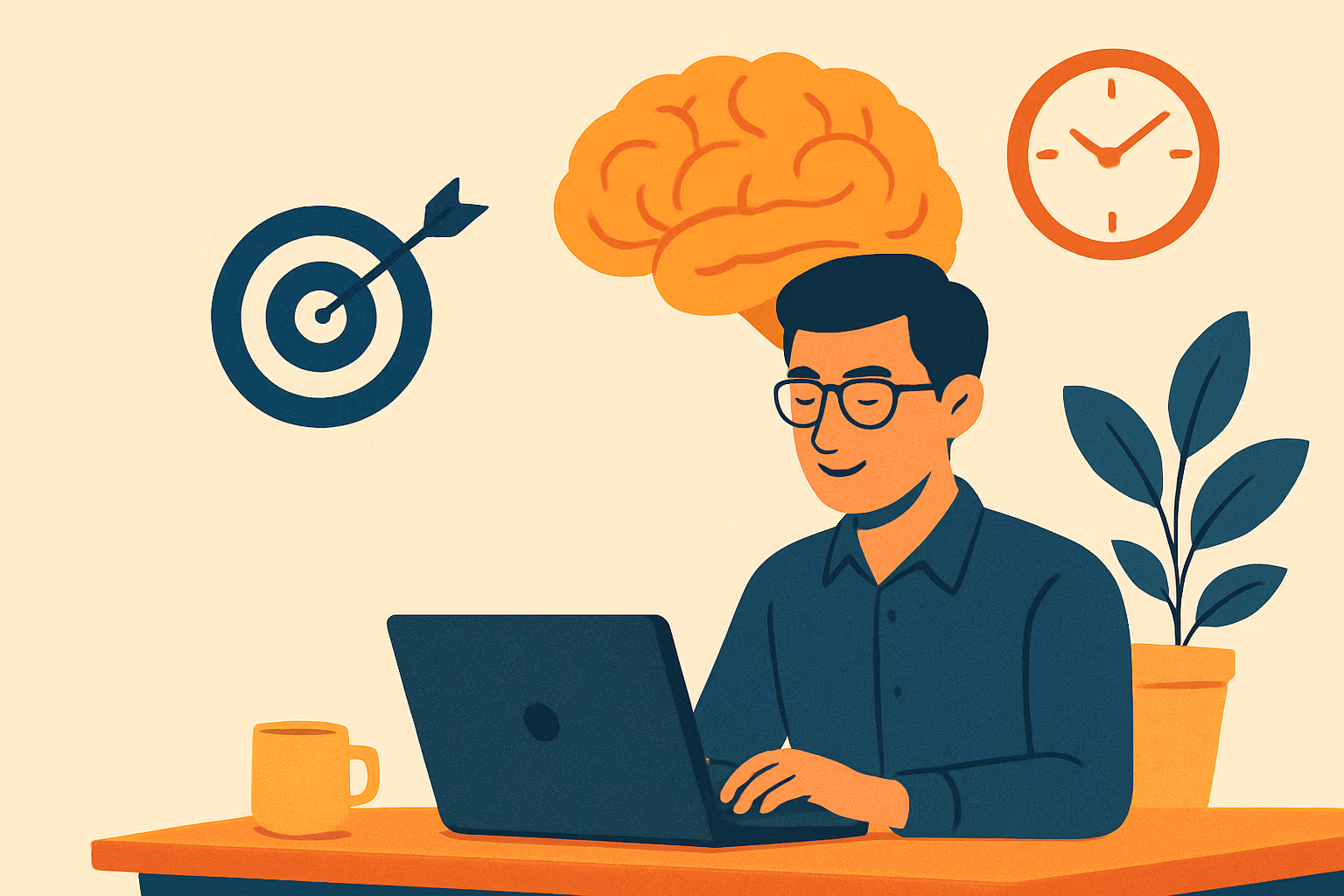
In an age of relentless pings, endless feeds, and the constant hum of connectivity, the ability to focus has become a modern superpower. The prevailing culture of immediacy rewards quick responses and visible busyness, yet the most valuable work—the kind that produces breakthrough innovations, deep insights, and masterful skill—requires something else entirely: sustained, uninterrupted concentration. This guide is a comprehensive roadmap to reclaiming your attention from the clutches of distraction. It provides a step-by-step framework for mastering the art of "deep work," a methodology for achieving extraordinary results by cultivating intense focus. We will move beyond simple productivity hacks to build a robust system for thinking deeply, producing high-quality output, and finding profound satisfaction in your professional life.
What is meant by deep work?
Deep work refers to professional activities performed in a state of distraction-free concentration that push your cognitive capabilities to their limit. These efforts create new value, improve your skills, and are hard to replicate. Coined by author and computer science professor Cal Newport, the concept distinguishes these high-value, cognitively demanding tasks from "shallow work"—the logistical, non-demanding tasks that often dominate the modern workday, such as answering emails, attending routine meetings, and managing social media. Deep work is the engine of high-level performance and mastery in any field.
What are the key principles of deep work?
The practice of deep work is built upon four core principles or "rules," as outlined by Cal Newport. First, Work Deeply: This involves integrating deep work sessions into your schedule through various philosophies, such as monastic (isolating oneself completely), bimodal (dividing time between deep and shallow pursuits), rhythmic (making it a regular habit), or journalistic (fitting it in wherever possible). Second, Embrace Boredom: This principle advocates for training your focus and resisting the constant urge for distraction, thereby strengthening your ability to concentrate when needed. Third, Quit Social Media: This involves a critical evaluation of the tools you use, abandoning those that offer low value in favor of more intentional, high-impact activities. Fourth, Drain the Shallows: This rule focuses on systematically reducing the amount of shallow work in your schedule through techniques like meticulous scheduling, setting clear communication protocols, and becoming difficult to reach.
What are the benefits of practicing deep work regularly?
Regularly engaging in deep work yields substantial professional and personal benefits. Primarily, it dramatically increases the quality and quantity of your output, enabling you to produce elite-level results in less time. By pushing your cognitive limits, deep work is one of the most effective ways to quickly master complex skills and acquire new knowledge, a critical advantage in a rapidly changing economy. This practice also brings a profound sense of fulfillment and satisfaction, as it connects you more closely with the craft of your work and allows you to see tangible, high-impact results from your efforts. Ultimately, it provides a competitive edge, making you more valuable in your field by developing a skill that is becoming increasingly rare.
Introduction: Reclaiming Your Focus in a Distracted World
We live and work in an economy that increasingly values complex problem-solving, creativity, and rapid skill acquisition. Yet, the very tools and workplace cultures designed to enhance productivity often become the primary obstacles to achieving it. The constant barrage of emails, notifications, and meetings creates a state of perpetual distraction, making it nearly impossible to engage in the kind of focused thought required for high-caliber work. This guide is designed to provide a structured path out of this chaotic environment and into a state of focused success.
The Epidemic of Distraction: Why Focus is Our Most Valuable Asset
Our modern professional landscape is characterized by what Cal Newport terms a "Distracted World." The expectation of constant availability and the allure of social media platforms have fragmented our attention into a thousand tiny pieces. Each time we switch from a primary task to check an email or glance at a notification, we incur a cognitive cost. This phenomenon, known as attention residue, means a part of our cognitive capacity remains stuck on the previous task, reducing our ability to perform the current one at full intensity. Over a day, this constant context-switching severely degrades our mental performance. In this environment, the ability to sustain deep, prolonged focus is not just a personal productivity hack; it is the fundamental currency for creating value and advancing professionally.
Introducing Deep Work: The Path to Uninterrupted Focus and Breakthrough Results (Cal Newport)
The antidote to this epidemic of distraction is Deep Work. This concept, popularized by Cal Newport in his seminal book, Deep Work: Rules for Focused Success in a Distracted World, provides a framework for cultivating the skill of intense, uninterrupted concentration. Newport argues that in the 21st-century economy, two core abilities will determine success: the ability to quickly master hard things and the ability to produce at an elite level, in terms of both quality and speed. Both of these abilities depend directly on your capacity for deep work. By intentionally structuring your life and work to accommodate periods of profound focus, you can escape the cycle of busyness and begin producing meaningful, breakthrough results.
What You’ll Learn: A Step-by-Step Journey to Mastery
This article will guide you through a systematic process to integrate deep work into your life. We will begin by establishing a clear understanding of what deep work is and why it is so powerful. Next, we will diagnose the specific distractions—both internal and external—that sabotage your focus. From there, we will move into the practical application, covering how to design your physical and digital environments for concentration. Finally, you will receive a step-by-step guide to implementing deep work sessions, complete with strategies for scheduling, execution, and long-term integration. This journey is about transforming your relationship with your work, moving from a reactive state of distraction to a proactive state of deep, Focused Success.
Understanding Deep Work: The Foundation for Extraordinary Achievement
Before implementing any new methodology, it's crucial to understand its core components and the principles that give it power. Deep work is more than just "focusing hard"; it's a structured practice grounded in cognitive science and deliberate practice. Understanding its distinction from its more common counterpart, shallow work, and appreciating the mechanics behind its effectiveness are the first steps toward mastery.
Defining Deep Work: Sustained Concentration on Cognitively Demanding Tasks
At its core, deep work is defined as: Professional activities performed in a state of distraction-free concentration that push your cognitive capabilities to their limit. This definition has two critical parts. First, "distraction-free concentration" implies a zero-tolerance policy for interruptions. This means no email pop-ups, no phone notifications, and no quick checks of social media. It requires creating a sanctuary for your mind. Second, "push your cognitive capabilities to their limit" means the task must be challenging. Deep work is not about mindlessly executing a known procedure; it's about grappling with a difficult problem, learning a complex new skill, or synthesizing information to create a novel strategy. It’s the state you enter when writing a critical piece of code, drafting a legal argument, or developing a complex business plan.
Deep Work vs. Shallow Work: Distinguishing the High-Value from the Low-Value
To fully appreciate deep work, one must understand its opposite: shallow work. Shallow work encompasses non-cognitively demanding, logistical-style tasks, often performed while distracted. These activities tend to be easy to replicate and create little new value in the world. Examples are abundant in the modern office: answering routine emails, attending status update meetings, posting on social media, and organizing files. While some shallow work is unavoidable, the danger lies in its tendency to expand and fill the entire workday. It provides a comforting illusion of productivity—our inboxes are clear, our calendars are full—but it contributes minimally to long-term goals and skill development. The ability to ruthlessly identify, minimize, and consolidate shallow work is a prerequisite for making time for deep work.
The Power of Uninterrupted Focus: Why Deep Work Leads to Breakthroughs
The human brain is not designed for rapid context-switching. When you work on a single, hard task for a prolonged and uninterrupted period, you engage in a process of intense neural activation. Specific neural circuits related to the task are fired repeatedly and in concert, strengthening their connections through a process called myelination. This is the biological mechanism of learning and skill-building. By dedicating blocks of time to a single cognitive challenge, you are literally rewiring your brain for mastery. This sustained focus allows you to move beyond surface-level understanding and grapple with the deeper, more complex layers of a problem. It is in these depths that novel connections are made, innovative solutions are discovered, and true breakthroughs occur.
The Hidden Costs of Constant Distraction: Attention Residue and Cognitive Overload
The primary enemy of deep work is distraction, and its cost is far greater than just the time the interruption takes. As mentioned earlier, the concept of attention residue reveals that even a momentary glance at your inbox can leave a portion of your cognitive resources stuck on the previous task. This residue makes it harder to re-engage with the primary task and reduces the overall quality of your focus. When a workday is filled with dozens of such switches, your brain is operating at a fraction of its potential. This leads to cognitive overload, mental fatigue, and a diminished capacity for creative and critical thinking. The constant state of semi-distraction fostered by modern tools and work habits is not a benign background noise; it is an active drain on the very cognitive resources needed to produce high-value work.
Diagnosing Your Distraction Landscape: Identifying Your Focus Killers
To build a fortress of focus, you must first understand the forces besieging it. Distractions are not a monolithic entity; they come in various forms, from the digital pings on our devices to the cultural norms of our workplaces. A successful deep work practice begins with a thorough and honest audit of your personal distraction landscape. By identifying your specific "focus killers," you can develop targeted strategies to neutralize them.
The Distracted World: How Digital Technology and Social Media Sabotage Your Attention
We live in an attention economy where countless companies, from software developers to social media platforms, are vying for fragments of our cognitive bandwidth. Their business models often depend on maximizing user engagement, which translates to designing products that are inherently distracting. Infinite scrolls, notification badges, and algorithmically curated feeds are engineered to trigger dopamine responses, creating behavioral loops that are difficult to break. This Distracted World trains our brains to crave novelty and constant stimulation, eroding our ability to tolerate the sustained, sometimes uncomfortable, focus required for deep work. The first step in reclaiming your attention is recognizing that many of the tools you use are not neutral; they are actively working against your ability to concentrate.
Internal vs. External Distractions: Understanding What Pulls You Away
Distractions can be broadly categorized into two types: external and internal. External distractions are environmental cues that pull your focus away from your intended task. These include email notifications, a colleague dropping by your desk, a phone call, or background noise. They are often easier to identify and manage through environmental controls. Internal distractions are far more insidious. These are the impulses that arise from within: the sudden urge to check a news website, the impulse to ruminate on an unrelated problem, or the feeling of restlessness that makes it difficult to sit with a single task. These internal triggers are often a symptom of a brain that has been rewired for distraction and has a low tolerance for boredom. Addressing them requires not just environmental changes, but a deliberate effort to retrain your attentional muscles.
The Open-Plan Office Challenge: Navigating Collaborative Environments for Deep Work
The rise of the open floor plan in corporate culture presents a significant structural barrier to deep work. Designed to foster collaboration and transparency, these environments often become hotbeds of distraction. Constant visual and auditory interruptions—colleagues' conversations, people walking by, phones ringing—make it nearly impossible to achieve the sustained, uninterrupted focus necessary for cognitively demanding tasks. While you may not be able to change your company's office layout, you can develop strategies to mitigate its effects. This might include using high-quality noise-canceling headphones, finding secluded "focus rooms" or quiet corners, communicating your need for uninterrupted time to colleagues, or adjusting your work hours to capitalize on quieter periods in the office.
Personal Audit: Pinpointing Your Unique Attention Switching Triggers
The final step in diagnosing your distraction landscape is a personal audit. For one week, keep a "distraction log." Every time you find yourself pulled away from a high-priority task, note what the trigger was. Was it a specific notification? An internal urge to check a particular app? A desire to escape the difficulty of the task? Be specific and honest. At the end of the week, analyze the log for patterns. You might discover that your focus crumbles in the mid-afternoon, or that a specific social media app is your primary kryptonite. This data is invaluable. It moves you from a general sense of being "distracted" to a precise understanding of your unique triggers, allowing you to create a targeted and effective defense system for your attention.
Building Your Deep Work Sanctuary: Mindset and Environment
Once you've diagnosed your key distractions, the next phase is to proactively build a sanctuary—both mental and physical—that is conducive to deep work. This involves more than just turning off your phone; it requires a fundamental shift in your mindset and a deliberate design of your work environment. This sanctuary is where you will train your focus and produce your most significant work.
Cultivating a Deep Work Mindset: Embracing Boredom and Deliberate Practice
The ability to concentrate is a skill, and like any skill, it requires training. In our hyper-stimulated world, we have conditioned our brains to expect constant novelty. The moment we feel a hint of boredom, we reach for our devices. To cultivate a deep work mindset, you must reverse this trend by deliberately embracing boredom. This doesn't mean seeking out boring activities, but rather learning to be comfortable without constant input. Practice waiting in line without looking at your phone or commuting without listening to a podcast. This practice rebuilds your "attention muscle," increasing your tolerance for sustained focus on a single, non-novel stimulus—a core requirement for deep work. This mindset also involves an embrace of deliberate practice: intentionally pushing yourself to the edge of your cognitive abilities, seeking feedback, and continuously refining your approach.
The Power of a Digital Detox and Social Media Detox: Resetting Your Attention Span
For many, the biggest obstacle to deep work is the reflexive, addictive relationship with digital tools, particularly social media. A powerful way to reset this relationship is to undertake a temporary but strict digital detox. Consider a 30-day period where you abstain from all optional digital technologies, especially distracting social media platforms. The goal is not necessarily to quit these tools forever, but to break the cycle of dependency. After the detox, you can reintroduce tools on your own terms, asking a critical question for each one: "Does this tool's value to my life and work significantly outweigh the negative impact on my attention?" This process helps transition you from a mindless consumer of digital stimuli to an intentional user, a philosophy Cal Newport explores in his book Digital Minimalism.
Designing Your Deep Work Environment: Optimizing Your Physical Space
Your physical surroundings have a profound impact on your ability to concentrate. The ideal deep work environment is one that signals to your brain that it's time to focus and minimizes the potential for external interruptions. This could be a dedicated home office with the door closed, a specific library carrel, a rented co-working space, or even a designated "deep work" chair. The key is consistency and clear boundaries. Optimize this space for focus: ensure it is decluttered, has good lighting, and contains all the resources you need (books, water, etc.) to avoid needing to get up during a session. If you work in a distracting environment like an open floor plan, your "environment" might be a pair of high-quality noise-canceling headphones and a "do not disturb" sign.
Crafting Your Digital Haven: Tools and Settings for Uninterrupted Work Sessions
Just as you optimize your physical space, you must also design your digital environment for focus. This involves moving from default settings, which are often optimized for engagement and distraction, to settings optimized for concentration. Turn off all non-essential notifications on your computer and smartphone. Use website blockers or apps that restrict access to distracting sites during your work blocks. Create a "deep work" user profile on your computer that has a clean desktop and limited access to distracting applications. The goal is to introduce friction. By making it slightly more difficult to access distractions, you give your prefrontal cortex a crucial moment to override the impulsive, distraction-seeking parts of your brain. This digital haven ensures that your tools serve your focus, not sabotage it.
Your Step-by-Step Guide to Implementing Deep Work Sessions
With a prepared mindset and a fortified environment, you are ready to begin the practice of deep work. This is not about waiting for inspiration to strike, but about a disciplined, repeatable process. The following four steps provide a clear structure for planning, executing, and refining your deep work sessions, transforming the concept from an abstract ideal into a practical, results-driven habit.
Step 1: Strategize Your Deep Work Schedule
The foundation of a consistent practice is scheduling. You must decide in advance when you will do deep work and for how long. Cal Newport outlines several philosophies for creating a Deep Work Schedule. The rhythmic approach is often the most practical, where you dedicate a specific, recurring block of time each day to deep work (e.g., 90 minutes every morning). The most effective way to implement this is through time blocking, where you divide your entire workday into blocks and assign a specific task to each one. A deep work block should be clearly marked and fiercely protected. Be realistic at first; if you're new to this, start with a 60-minute block and gradually increase the duration as your focus stamina improves. The goal is to make deep work a non-negotiable part of your routine, just like a critical meeting. For those with highly variable schedules, a "journalistic" approach might work, seizing unexpected blocks of free time for deep sessions. Another related philosophy is fixed-schedule productivity, where you commit to not working past a certain time, forcing you to maximize the focus and intensity within your working hours.
Step 2: Proactively Eliminate All Distractions
Before you begin a scheduled session, you must create a zero-distraction bubble. This is a non-negotiable ritual. Close all unnecessary tabs on your computer. Turn off your phone and put it in another room—"silent mode" is not enough, as the mere presence of the device can be a cognitive drain. If you're in an office, put on noise-canceling headphones and let your colleagues know you are unavailable for the duration of your session. Close your email client completely. Gather everything you will need—water, notebooks, research materials—so you have no excuse to get up. This pre-session ritual is critical because it removes the need to exert willpower resisting distractions during the session itself. Your finite mental energy can be directed entirely toward the cognitively demanding task at hand.
Step 3: Execute with Intense Focus
Once the session begins, your sole focus is on the task. This is where your training in embracing boredom pays off. You will inevitably feel the pull of internal distractions—the urge to check something, the mind wandering to another topic. Your job is to gently but firmly redirect your attention back to the task. One technique to maintain intensity is the Pomodoro Technique, where you work in focused 25-minute intervals separated by short breaks. This can be an excellent way to structure a longer deep work block and build focus stamina. It's also helpful to have a clear, specific goal for the session (e.g., "draft 500 words of the report" or "debug the user authentication module"). This clarity of purpose provides a target for your concentration and makes it easier to measure progress. The intensity of focus is just as important as the duration.
Step 4: Reflect and Refine Your Practice
Deep work is a skill that improves with feedback. After each session, take a few minutes to reflect. How long were you able to maintain focus before feeling a strong pull of distraction? What worked well in your environment or ritual? What didn't? Keep a simple log where you track the duration and intensity of your deep work sessions. This creates a feedback loop that allows you to identify what helps or hinders your focus. Perhaps you discovered that music with lyrics is distracting, or that your energy for deep work is highest in the morning. This process of reflection and refinement is crucial for sustainable improvement. It allows you to systematically optimize your practice, gradually increasing the depth and duration of your focus over time, leading to ever-greater results.
Integrating Deep Work for Sustained Mastery and Long-Term Results
Mastering deep work is not a one-time project but an ongoing commitment to a different way of working. The initial steps involve building the systems and environment, but long-term success depends on integrating these practices so deeply that they become a natural, indispensable part of your professional identity. It’s about shifting from occasional sprints of focus to a sustained marathon of high-quality output and continuous learning.
Making Deep Work a Habit: Consistency Over Intensity
The key to long-term success is consistency. It is far more effective to schedule and execute a 90-minute deep work session every day than to attempt a heroic eight-hour session once a month. Like physical exercise, the benefits of deep work compound over time. Regular, repeated sessions train your brain to enter a state of focus more quickly and stay there for longer. To support this habit, create powerful rituals. Your pre-session ritual of eliminating distractions signals to your brain that it's time to focus. Equally important is a post-session "shutdown" ritual, as Newport suggests. At the end of the workday, take a few minutes to review your tasks, make a plan for tomorrow, and formally declare your work is done for the day. This allows your mind to disengage fully, preventing work from bleeding into your personal time and enabling the rest and recovery necessary for the next day's deep efforts. This consistent practice, supported by robust rituals, transforms deep work from a technique into a cornerstone of your professional life.
Conclusion
The modern world is engineered for distraction, actively pulling us toward the shallow and away from the profound. The principles of deep work, championed by Cal Newport, offer a powerful and practical antidote. This is not merely another time management strategy; it is a fundamental reorientation of how we approach work, value, and skill development. By distinguishing high-impact deep work from low-impact shallow work, we can begin to reclaim our most valuable asset: our attention.
The journey begins with a diagnosis of your personal distraction landscape, identifying the forces from social media platforms and the open floor plan that fragment your focus and create costly attention residue. The solution lies in deliberately building a sanctuary for focus, cultivating a mindset that embraces boredom, and systematically designing your physical and digital environments to repel interruptions. Implementing a consistent Deep Work Schedule through techniques like time blocking allows you to transform theory into practice, executing with an intensity that produces breakthrough results.
Making this a lasting habit is the final and most crucial step. Consistency will always trump intensity. By integrating these practices into your daily routine, you build the "focus muscle" necessary for Focused Success in an increasingly competitive world. You start to envision a future where your work is defined not by the speed of your email responses, but by the depth of your insights and the quality of your creations—a mindset Newport explores in concepts like A World Without Email.
To begin your journey, start small but be deliberate. Schedule your first 60-minute deep work session for tomorrow. Audit your digital tools, removing one app that provides more distraction than value. For those seeking to delve further into these concepts, Cal Newport's books, including Deep Work: Rules for Focused Success in a Distracted World and Digital Minimalism, along with his Deep Questions podcast, offer a wealth of additional strategies. The path to mastery is challenging, but the rewards—elite performance, rapid skill acquisition, and a profound sense of professional fulfillment—are more than worth the effort.