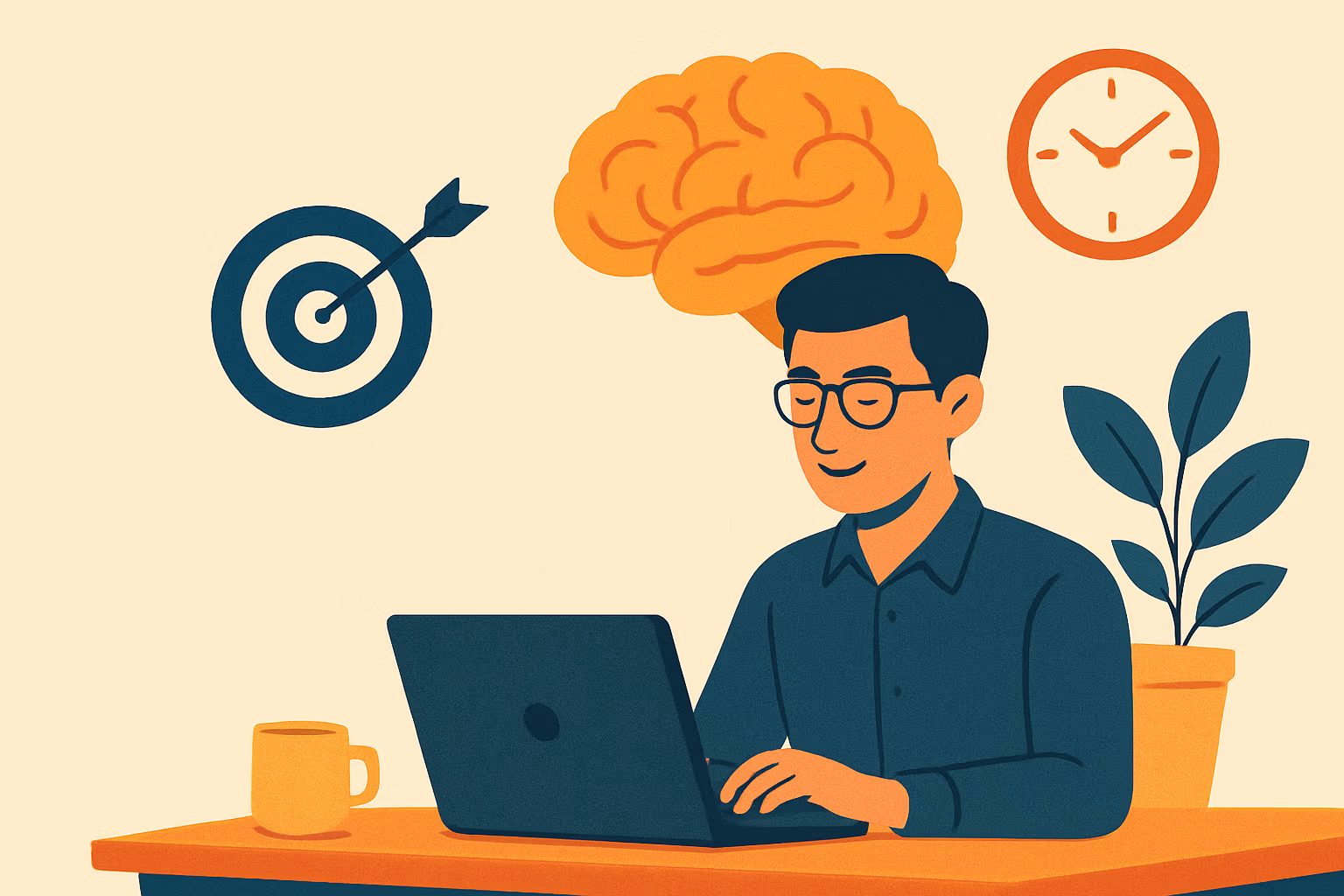
In an age of unprecedented connectivity, our ability to concentrate has never been more fragmented. The constant barrage of notifications, the allure of social media, and the pressure to multitask have created a modern paradox: we have more tools to be productive, yet genuine focus is increasingly elusive. This isn't just a minor inconvenience; it's a significant barrier to achieving our professional goals, cultivating meaningful relationships, and experiencing a deeper sense of engagement with life. Many of us feel this deficit acutely, with 68% of people reporting they lack sufficient uninterrupted focus time during the workday. The feeling of being pulled in a dozen directions at once generates stress and diminishes the quality of our output.
This article moves beyond simple tips and tricks to offer a comprehensive, systematic approach. It presents a 5-step blueprint designed not just to eliminate distractions, but to fundamentally retrain your attention and build a resilient capacity for deep, "unstoppable" focus. By understanding the psychology of distraction, architecting your environment, mastering your internal landscape, and executing with precision, you can reclaim your time and attention. This blueprint is a structured pathway to move from a state of reactive fragmentation to one of proactive, intentional concentration, unlocking higher levels of productivity and personal fulfillment.
Why is eliminating distractions important for productivity?
Eliminating distractions is fundamental to productivity because the human brain is not designed for rapid, constant task-switching. True productivity stems from sustained, deep focus on a single, high-value task. When distractions interrupt this flow, they impose a significant cognitive cost. Research highlights this penalty vividly; after checking a communication channel like Slack or email, it can take a person over 23 minutes to regain full focus on their original task. These "attention residue" costs accumulate throughout the day, drastically reducing both the quality and quantity of work accomplished.
Furthermore, a distracted work environment directly correlates with increased stress and diminished well-being. The constant feeling of being behind, coupled with the mental fatigue of continually re-engaging with tasks, contributes to burnout. Employees who frequently multitask are 2.5 times more likely to report symptoms of emotional exhaustion than their single-tasking peers. By consciously removing distractions, you are not just optimizing for output; you are creating the mental space necessary for creativity, critical thinking, and problem-solving. This controlled environment allows for the entry into "flow states," where work feels effortless and performance peaks. Ultimately, eliminating distractions is less about working harder and more about working smarter, protecting your most valuable cognitive resources to achieve meaningful results with less mental strain.
How can I eliminate or minimize distractions during focused work periods
Eliminating distractions during focused work periods requires a multi-layered strategy that addresses both external and internal triggers. The first layer is environmental control. This involves creating a physical "focus zone" that is decluttered and signals to your brain that it's time to concentrate. It also means establishing a digital fortress: turn off all non-essential notifications on your phone and computer, close unnecessary browser tabs, and use website-blocking apps if you are prone to mindlessly checking social media or news sites. A staggering 73% of Americans say they feel more distracted now than five years ago, primarily due to digital devices, underscoring the need for these digital boundaries.
The second layer is temporal and social. Time-blocking is a powerful technique where you schedule specific, uninterrupted blocks of time in your calendar for deep work. During these periods, communicate your unavailability to colleagues and family. This could mean setting a "do not disturb" status on communication apps or simply informing others that you will be unavailable for the next 90 minutes. This prevents interruptions from unplanned meetings, which are often unproductive—with some studies suggesting 72% of meetings are considered unproductive. Finally, addressing internal distractions is key. Before starting a task, take two minutes to write down any nagging thoughts or to-dos. This "brain dump" clears your mental cache, allowing you to engage with the task at hand without your mind wandering to other obligations. By combining environmental, temporal, and mental tactics, you create a robust defense against interruptions.
How can mindfulness techniques help in reducing distractions?
Mindfulness techniques are a powerful tool for reducing distractions because they train the core "muscle" of attention itself. At its heart, distraction is the act of the mind being pulled away from its intended point of focus. Mindfulness is the practice of repeatedly and non-judgmentally bringing the mind back to a single point of focus, such as the breath. This practice directly counteracts the mental habit of distraction, strengthening the neural pathways associated with sustained attention and executive control. Instead of being a passive victim of a wandering mind, mindfulness cultivates the ability to notice when your attention has strayed and gently guide it back.
This mental training has profound effects on both internal and external distractions. For internal distractions—like worry, rumination, or a racing mind—mindfulness teaches you to observe these thoughts as transient mental events rather than urgent commands that must be acted upon. This creates a crucial space between impulse and action, reducing the power of a random thought to derail your focus on an important task. For external distractions, a mindful brain is less easily "hooked." You become more aware of the impulse to check your phone at the slightest ping or feeling of boredom. This heightened awareness allows you to make a conscious choice to ignore the distraction and remain on task. The benefits extend beyond immediate focus; studies show that mindfulness practices can reduce anxiety levels by 30% within two months, proving as effective as some conventional medications. By reducing underlying stress, you lower the baseline of internal noise, making sustained focus more accessible.
Step 1: Laying the Foundation – Understanding Your Focus Landscape
Before you can build a fortress of focus, you must first survey the land and understand the forces you are up against. This foundational step is about moving from a vague feeling of being distracted to a clear, data-driven understanding of what specifically hijacks your attention, when, and why. It involves honest self-assessment and observation to create a personal map of your distraction triggers and patterns. Without this initial diagnostic phase, any attempt to improve focus will be based on generic advice rather than a targeted strategy tailored to your unique challenges. This step isn't about immediate solutions; it's about gathering the critical intelligence needed to make the subsequent steps effective.
Defining Distraction: More Than Just Your Phone
The first part of this assessment is broadening your definition of distraction. While digital devices like your phone are obvious culprits, a distraction is anything that pulls you away from your intended object of focus. It's crucial to categorize these into three distinct types.
First, External-Digital distractions are the most commonly recognized: the notifications from social media, the constant influx of email, the unplanned calls, and the endless scroll of news feeds.
Second, External-Physical distractions originate from your immediate environment. This includes a noisy coworker, an uncomfortable chair, a cluttered desk, or even family members interrupting you while you work from home. These sensory inputs compete for your brain's processing power.
Third, and most insidiously, are Internal distractions. These are the thoughts, feelings, and physiological sensations that arise from within. They include worrying about a future event, ruminating on a past conversation, feeling hungry or tired, or experiencing the internal pull of stress or boredom that makes you seek an external escape. Recognizing that a sudden urge to check social media is often triggered by an internal feeling of discomfort is a critical insight. True focus management requires addressing all three categories, as ignoring the internal landscape will inevitably lead to seeking external diversions.
The Hidden Costs of Fragmented Attention
Understanding the true cost of these distractions is a powerful motivator. A fragmented day isn't just inefficient; it's cognitively and emotionally draining. Every time you switch from your primary task to a distraction—whether it's a quick email check or a glance at your phone—you incur a "context-switching" penalty. Your brain has to disengage from one complex set of information and load another, and then repeat the process to get back on track. This isn't seamless. As noted earlier, it can take over 20 minutes to fully re-immerse yourself in a complex task after even a brief interruption.
This constant switching erodes your cognitive performance throughout the day. It leads to more errors, shallower thinking, and diminished creativity. The problem is accelerating; data shows that the average time spent on one screen before switching has plummeted from 2.5 minutes in 2004 to a mere 47 seconds in 2023. This hyper-fragmentation prevents you from ever reaching a state of "deep work," where the most valuable and innovative thinking occurs. Furthermore, this state of perpetual semi-distraction contributes to a low-grade, chronic stress. The feeling of being busy but not productive is a direct result of a day fractured by constant interruptions, leaving you exhausted without a sense of meaningful accomplishment.
Self-Assessment: Identifying Your Personal Distraction Triggers
With a clear understanding of what distractions are and what they cost, the final piece of this foundation is to identify your specific triggers. This requires a period of mindful observation, acting as a detective of your own habits. For one or two workdays, keep a simple "distraction log."
On a piece of paper or in a document, create four columns:
- Time: When did the distraction occur?
- Distraction: What was the specific distraction (e.g., checked Instagram, talked to a coworker, worried about a deadline)?
- Internal Trigger: What was the feeling or thought right before the distraction? (e.g., bored, stuck on a problem, anxious, hungry).
- Task: What were you supposed to be working on?
After a day or two, you will have invaluable data. You might notice you are most prone to checking your phone in the mid-afternoon when your energy dips. You might realize that feeling overwhelmed by a large task is a primary trigger for seeking the easy dopamine hit of email. This log uncovers the "why" behind your distractions. It reveals your patterns of avoidance, your peak focus times, and your most potent internal and external triggers. This personalized intelligence is the cornerstone upon which you will build your entire focus strategy in the steps that follow.
Step 2: Architecting Your Environment – Minimizing External Noise
Once you have identified your primary distraction triggers, the next step is to become the deliberate architect of your surroundings. This involves proactively shaping your physical and digital environments to make focus the path of least resistance and distraction a deliberate, high-friction choice. Your environment sends constant cues to your brain about how to behave. By engineering these cues to support concentration, you reduce your reliance on finite willpower to stay on task. This step is about systematically removing the external triggers you identified in your self-assessment, creating a sanctuary for deep work.
Digital Fortification: Taming Your Devices and Apps
In our modern world, the most significant external battles are fought on our screens. Digital fortification is the process of turning your devices from masters of your attention into tools that serve your intentions. Start with a notification audit. Go through every app on your phone and computer and turn off all non-essential notifications. Banners, sounds, and badge icons are designed to hijack your attention. Be ruthless; the default should be "off" unless a notification is truly time-sensitive and critical.
Next, curate your device home screens. Move distracting apps like social media, news, and games off the first screen and into folders. This simple act adds a moment of friction, forcing you to consciously seek out the distraction rather than opening it out of habit. For web browsers, use extensions that can block distracting websites during specific work periods. Finally, manage your communication channels. Close your email client and messaging apps when you are in a focus block. Schedule specific, short times throughout the day to check and process them in batches. This transforms communication from a constant stream of interruptions into a planned task, allowing you to reclaim vast stretches of uninterrupted time. The average worker spends 2.35 hours per day on social media, a time sink that can be dramatically reduced with these fortification strategies.
Physical Space Optimization: Crafting Your Focus Zone
Your physical environment has a profound impact on your ability to concentrate. The goal is to create a space that is dedicated solely to focused work. If possible, designate a specific room or corner of a room as your workspace. This builds a strong psychological association; when you enter this space, your brain understands it's time to work.
Begin by decluttering. A messy desk creates visual noise that competes for your attention and can increase cognitive load. Keep only the essential tools for the task at hand within arm's reach. Everything else should be stored away. Ensure your workspace is ergonomically sound—a comfortable chair and proper screen height prevent physical discomfort from becoming an internal distraction.
Control the sensory inputs. Use noise-canceling headphones to block out auditory distractions, especially in an open-plan office or a busy home. Pay attention to lighting; good, natural light can improve mood and energy levels. Lastly, clearly delineate the boundary of your focus zone. If you work from home, have a conversation with your family or roommates about when you are in a focus block and should not be disturbed except for emergencies. A simple sign can serve as a polite but firm visual cue, protecting your most productive periods.
Strategic Scheduling: Time-Blocking for Uninterrupted Work
Architecting your environment isn't just about space; it's also about time. Strategic scheduling is the practice of proactively defending your focus against the encroachments of a reactive workday. The most effective method is time-blocking, where you divide your day into dedicated blocks for specific tasks or types of work.
Start each day or the evening before by looking at your to-do list and your calendar. Instead of just having a list of tasks, assign them to specific time blocks on your calendar. For high-concentration work, schedule 60- to 90-minute "deep work" blocks. Treat these appointments with yourself as seriously as you would a meeting with your boss. During these blocks, you commit to single-tasking with all environmental controls in place.
Also, schedule blocks for "shallow work," such as responding to emails, making calls, or administrative tasks. Batching these together prevents them from splintering your focus throughout the day. Crucially, you must also schedule breaks. Deliberate rest is not a waste of time; it's essential for cognitive recovery and sustained performance. By creating a clear plan for your day, you replace decision fatigue and reactive task-switching with intentional, focused execution.
Step 3: Cultivating Internal Resilience – Mastering Your Mind's Landscape
While controlling your external environment is a critical first step, it is ultimately insufficient for achieving unstoppable focus. The most persistent and challenging distractions are not the notifications on our screens, but the thoughts, emotions, and impulses that arise from within our own minds. This step moves inward, focusing on building the mental resilience to manage this internal landscape. It involves training your attention as a skill, understanding the psychological patterns that lead you off-task, and adopting lifestyle habits that support cognitive function. This is where you transform from someone who is merely avoiding distractions to someone who can maintain focus even in their presence.
The Power of Presence: Mindfulness and Meditation Practices
Mindfulness and meditation are the foundational practices for strengthening your "attention muscle." As discussed earlier, these techniques are essentially resistance training for your brain's focus circuits. A simple yet powerful practice is focused-attention meditation. Sit in a quiet place for 5-10 minutes each day. Close your eyes and bring your full attention to the physical sensation of your breath. Your mind will inevitably wander—this is normal. The core of the practice is not to have a perfectly clear mind, but to notice when your attention has drifted and gently, without judgment, guide it back to your breath.
Each time you perform this act of noticing and returning, you are strengthening the prefrontal cortex, the area of your brain responsible for executive functions like concentration and impulse control. This practice directly translates to your workday. You become quicker at noticing when your mind has strayed from a report to worrying about a family matter, and it becomes easier to redirect your focus back to the task. This cultivation of presence helps manage the internal chatter that so often precedes reaching for an external distraction.
Re-training Your Brain: Overcoming the Distraction Habit
Many of our distraction-seeking behaviors are deeply ingrained habits, often rooted in principles from Cognitive Behavioral Therapy (CBT). A common pattern is this: an uncomfortable internal state (the trigger), such as boredom, anxiety, or the difficulty of a complex task, leads to the habitual behavior (the routine) of seeking a distraction like checking social media, which provides a brief feeling of relief (the reward). To break this cycle, you must first bring awareness to it, as you did in the Step 1 self-assessment.
When you feel the urge to get distracted, pause. Identify the underlying feeling. Is it frustration? Fatigue? Instead of immediately giving in, apply a "distress tolerance" technique from Dialectical Behavior Therapy (DBT), such as the "5-4-3-2-1" grounding exercise: name five things you can see, four things you can feel, three things you can hear, two things you can smell, and one thing you can taste. This brief mindfulness exercise breaks the automatic link between discomfort and distraction, giving your rational mind a chance to re-engage and make a conscious choice to stay on task. Over time, this practice rewires your brain to tolerate mild discomfort without needing an immediate escape, fundamentally weakening the power of internal triggers.
Fueling Your Focus: Lifestyle Habits for Cognitive Health
Your brain's ability to focus is not just a matter of mental training; it is deeply connected to your physical health. Three key lifestyle factors directly impact your cognitive performance: sleep, nutrition, and exercise.
Sleep is when your brain consolidates memories and clears out metabolic waste products that accumulate during the day. A lack of quality sleep impairs the function of the prefrontal cortex, leading to decreased attention, poor decision-making, and emotional volatility. Aim for 7-9 hours of quality sleep per night.
Nutrition provides the fuel for your brain. A diet high in processed foods and sugar can lead to energy crashes and brain fog. Focus on a balanced diet rich in omega-3 fatty acids (found in fish and nuts), antioxidants (found in berries and leafy greens), and complex carbohydrates for sustained energy release. Proper hydration is also critical; even mild dehydration can impair concentration.
Exercise increases blood flow to the brain, delivering vital oxygen and nutrients. It also stimulates the release of brain-derived neurotrophic factor (BDNF), which supports the health of existing neurons and encourages the growth of new ones. Regular physical activity, even a brisk 20-minute walk, can have immediate and lasting benefits for focus and cognitive clarity.
Step 4: Executing with Precision – The Art of Deep Work
With a controlled environment and a resilient internal landscape, you are now prepared to engage in the act of focused execution itself. This step is about translating your capacity for focus into tangible, high-quality output. It involves shedding the pervasive myth of multitasking, structuring your work for maximum clarity, and learning to harness the psychological state of "flow" for peak performance. This is where your cultivated focus meets a strategic workflow, enabling you to tackle your most important tasks with unparalleled depth and efficiency.
Single-Tasking Mastery: Ditching the Myth of Multitasking
The modern workplace often glorifies multitasking, but neuroscience reveals a starkly different reality. The brain does not truly multitask; it simply switches between tasks with incredible speed. As previously noted, this rapid switching comes with a severe cognitive cost, with studies showing that multitasking can reduce productivity by up to 40%. To execute with precision, you must commit to the discipline of single-tasking.
This means dedicating your full cognitive resources to one and only one task during a focused work block. When you are writing a report, you are only writing the report. You are not simultaneously checking email, monitoring a chat window, or half-listening to a podcast. This requires conscious effort. When the urge to switch tasks arises, acknowledge it and gently return your focus to the primary task. This practice is not just about efficiency; it's about quality. Single-tasking allows for the depth of thought required for complex problem-solving, strategic planning, and creative endeavors—work that is impossible to do well while your attention is divided.
Project Deconstruction and Prioritization
Often, the biggest obstacle to starting and staying focused on a task is its sheer size and ambiguity. A vague goal like "work on the quarterly project" is a recipe for procrastination because the brain doesn't have a clear, concrete action to take. The solution is project deconstruction.
Break down every large project or goal into its smallest, most actionable components. A "quarterly project" becomes a series of specific tasks: "research competitor data," "create outline for presentation," "draft section one," "design slide deck." Each of these tasks should be small enough to be completed in a single focus session.
Once deconstructed, you must prioritize. Use a framework like the Eisenhower Matrix (urgent/important) or simply ask: "What is the one task that, if completed, will make the biggest impact on my goals?" Identify the 1-3 most critical tasks for the day and dedicate your peak energy and focus blocks to them. This clarity eliminates the "what should I do next?" paralysis, providing a clear roadmap for your attention and ensuring your focused energy is directed at what truly matters.
Leveraging Flow States for Peak Performance
A "flow state," also known as being "in the zone," is the pinnacle of focused execution. It's a state of deep immersion in an activity where you feel energized, fully involved, and are performing at your best. While flow can feel elusive, you can create the conditions that make it more likely to occur.
First, flow requires a clear goal and immediate feedback. The project deconstruction you performed helps with this; you know exactly what you're trying to achieve in a given session. Second, the task must be a good match for your skill level—challenging enough to keep you engaged, but not so difficult that it becomes overwhelming. Third, and most importantly, flow requires a prolonged period of uninterrupted concentration. This is why the environmental and internal controls from Steps 2 and 3 are so crucial.
To enter a flow state, commit to a focus block of at least 90 minutes. Eliminate all potential distractions. Begin with the clear, challenging task you've identified. The first 15-20 minutes can feel like a struggle as your brain resists settling down. Push through this initial friction. As you become more engrossed, your sense of time may fade, self-consciousness disappears, and the work itself becomes its own reward. Actively seeking and protecting the conditions for flow is how you leverage your focus for truly exceptional results.
Step 5: Sustaining Unstoppable Focus – Building a Lifelong Practice
Achieving deep focus for a day or a week is an accomplishment, but the ultimate goal is to integrate these principles into a sustainable, lifelong practice. This final step is about transforming conscious effort into unconscious habit, ensuring that your ability to concentrate remains robust over the long term. It involves understanding the mechanics of habit formation, the critical role of strategic rest, and the expansion of focus beyond work to enhance all areas of your life. This is how "unstoppable focus" evolves from a temporary state into a core component of your identity.
Habit Formation and Continuous Improvement
The strategies outlined in this blueprint—from managing notifications to time-blocking—are most effective when they become automatic habits. Habits are formed through a cue-routine-reward loop. For example, the cue of sitting down at your desk in the morning (cue) can trigger a new routine of spending 5 minutes planning your day and identifying your top priorities (routine), leading to a feeling of clarity and control (reward).
To build these focus-enhancing habits, start small. Don't try to implement every strategy at once. Pick one or two key habits, such as a 10-minute morning meditation or a nightly digital shutdown an hour before bed. Practice them consistently for several weeks until they feel effortless. Track your progress and celebrate small wins to reinforce the new behavior.
Furthermore, adopt a mindset of continuous improvement. Regularly (perhaps weekly) review your focus practices. What worked well? Where did you struggle? Were new distractions creeping in? Just as you would regularly maintain a car, you must regularly maintain your focus systems. This process of reflection and adjustment ensures your strategies evolve with your changing life and work demands, preventing you from sliding back into old, distracted patterns.
Strategic Recharge: The Power of Deliberate Breaks
Sustained focus is not a marathon of relentless effort; it's a series of sprints with planned recovery periods. Your brain's capacity for intense concentration is a finite resource that needs to be replenished. Ignoring this biological reality leads directly to cognitive fatigue, diminished performance, and burnout. Strategic recharging is therefore a non-negotiable component of a sustainable focus practice.
Incorporate short breaks throughout your workday. Techniques like the Pomodoro Method (25 minutes of focus followed by a 5-minute break) are effective. During these micro-breaks, it is crucial to do something that is truly restorative. Stepping away from all screens is ideal. Stretch, walk around, look out a window, or simply close your eyes and breathe.
In addition to micro-breaks, ensure you take a longer lunch break away from your desk. Your evenings and weekends are also critical for deeper recovery. Disconnect from work-related thoughts and engage in hobbies, spend time in nature, and connect with friends and family. This "deliberate rest" isn't idleness; it's the biological process that allows your brain to consolidate information, generate new ideas, and restore the energy needed for the next period of deep focus.
Beyond Productivity: Integrating Focus into Your Life
The ultimate purpose of cultivating unstoppable focus extends far beyond checking more items off a to-do list. It's about enhancing the quality of your entire life. The same skills you use to concentrate on a work project can be applied to being more present with your family, listening more deeply to your friends, and engaging more fully with your hobbies.
When you are with your family, practice putting your phone away and giving them your undivided attention. When you are reading a book or listening to music, try to immerse yourself in the experience without a wandering mind. This practice of "attentional presence" enriches your relationships and brings a greater sense of meaning and fulfillment to your personal time.
Ultimately, focus is the currency of a well-lived life. Where you choose to direct your attention determines the reality you experience. By mastering your focus, you gain the power to consciously choose what you engage with, moving from a life of frantic, distracted reactivity to one of intentional, meaningful engagement. This blueprint provides the tools not just to be more productive, but to be more present and purposeful in every aspect of your existence.
Conclusion
The journey to achieving unstoppable focus is not about finding a magic bullet but about implementing a deliberate, systematic blueprint. We've explored the critical five steps that form this system: laying a foundation of self-awareness by understanding your unique distraction landscape; architecting your external environment to make focus the default; cultivating internal resilience to manage the thoughts and feelings that pull you off task; executing with precision through single-tasking and leveraging flow states; and finally, sustaining this ability through habit formation and strategic rest. Each step builds upon the last, creating a comprehensive defense against the fragmentation of modern life.
The core takeaway is that focus is not an innate talent but a trainable skill. Simply removing external distractions is only half the battle. True mastery comes from strengthening your internal "attention muscle" through mindfulness and developing healthier cognitive habits, supported by a lifestyle that fuels brain health. By applying principles from cognitive science, you can rewire your brain to resist the constant pull of distraction and engage more deeply with the tasks and people that matter most.
Your next step is to begin. Do not feel overwhelmed by the need to implement everything at once. Start with Step 1: spend the next two days simply observing and logging your distractions. This single act of awareness is the most powerful first move you can make. From there, choose one strategy from Step 2, like turning off phone notifications, and one from Step 3, such as a five-minute daily meditation. By taking small, consistent actions, you will begin to reclaim your time, reduce your stress, and unlock a level of productivity and presence you may have thought was no longer possible. The power to direct your attention is the power to shape your life—begin building your blueprint today.