
Human experience is often defined by patterns. We build routines for efficiency, form habits for comfort, and develop responses based on past events. While many of these patterns serve us, others can become invisible cages, trapping us in cycles of negative thought, behavior, and emotion. These cycles—whether they manifest as procrastination, anxiety, unhealthy relationships, or more severe challenges like substance use—can feel inescapable, dictating the narrative of our lives. But within the human brain lies an extraordinary capacity for change. Breaking the cycle is not a matter of chance or sheer willpower; it is a deliberate process of understanding, intervention, and reconstruction.
This article provides a comprehensive, five-step framework for reclaiming your narrative. It moves beyond simplistic advice to offer a roadmap grounded in neuroscience, psychology, and practical strategy. By understanding the mechanics of your patterns and systematically applying these essential steps, you can dismantle the structures that hold you back and build a foundation for lasting, meaningful change. This journey is about more than just stopping a bad habit; it's about a fundamental movement toward self-awareness, empowerment, and a future designed by you.
What does it mean to break the cycle?
Breaking the cycle means consciously interrupting and altering a recurring, negative pattern of thought, emotion, or behavior. This pattern may be personal, such as a cycle of self-sabotage or anxiety, or it can be interpersonal and generational, like patterns of communication or coping mechanisms learned in childhood. At its core, breaking the cycle is an act of agency. It involves moving from an automatic, often subconscious, response to a deliberate, chosen action. It is the process of recognizing that a current trajectory is leading to undesirable outcomes and taking the necessary steps to forge a new path, thereby preventing the repetition of harmful history and creating new potential for personal development and well-being.
How can someone break the cycle of negative behavior or habits?
 Lasting change is a systematic process of awareness, disruption, replacement, and reinforcement to build a new pathway.
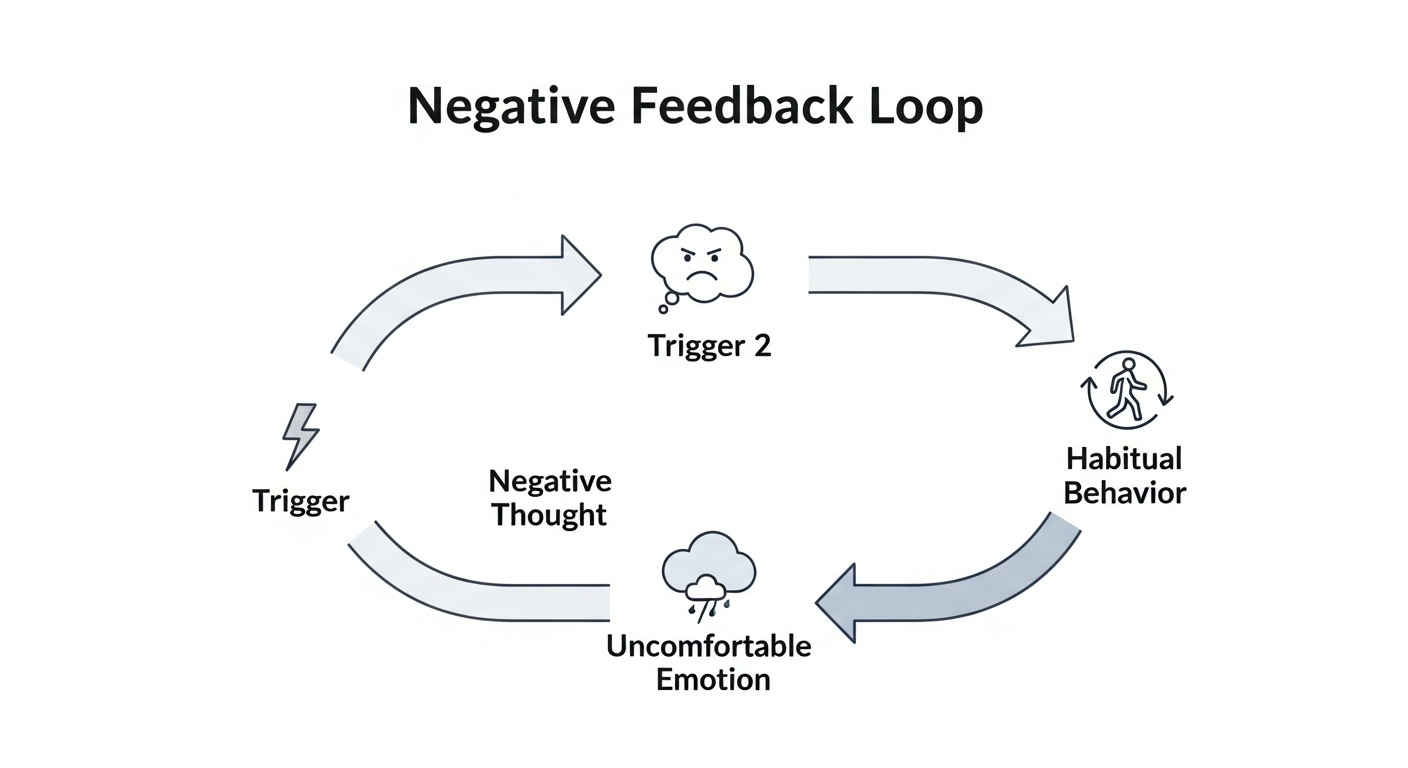 A negative pattern is a self-reinforcing loop where a trigger leads to automatic thoughts, emotions, and behaviors.
An individual can break the cycle of negative behavior by moving from a state of passive reaction to one of active engagement with their own internal processes. The key is to transform the feeling of being miserable into a catalyst for action. This begins with cultivating deep awareness—identifying the specific triggers, thoughts, and feelings that initiate the negative loop. From there, it requires intentional intervention: creating a pause between the trigger and the habitual response. This space allows for the introduction of a new, more constructive behavior. Lasting change is solidified by consistently practicing this new response, building new neural pathways in the brain, and creating a supportive environment that reinforces the desired change rather than the old pattern. It is a systematic process of awareness, disruption, replacement, and reinforcement.
Introduction: The Power to Reclaim Your Narrative
Understanding the Grip of Negative Patterns
Negative patterns are more than just bad habits; they are deeply ingrained scripts that run automatically in our minds and bodies. These cycles can encompass a wide spectrum of human experience, from the seemingly minor loop of negative self-talk that undermines confidence to the devastating grip of addiction or the perpetuation of relational dysfunction. They often serve a purpose, at least initially, as coping mechanisms developed in response to stress, trauma, or unmet needs. A pattern of avoidance might protect from perceived threats, while substance use may temporarily numb emotional pain. Research highlights the pervasive nature of these mental loops; studies suggest that approximately 75% of our daily thoughts are negative, and 95% are repetitive, underlining the powerful, cyclical nature of our internal dialogue. Understanding that these patterns are not a sign of weakness but are often outdated survival strategies is the first step toward dismantling their power.
Why Breaking Free Feels So Hard (and Why It's Possible)
The difficulty in breaking a negative cycle is rooted in our biology. The brain is an efficiency engine, preferring to run on established neural pathways rather than forging new ones, which requires more energy. When a behavior is repeated, particularly one linked to a strong emotional response or a chemical reward, the neural connections for that pattern become stronger, like a well-trodden path in a forest. This makes the automatic response quicker and easier than a new, conscious choice. Furthermore, these cycles can become intertwined with our identity, making the prospect of change feel like a threat to our sense of self. Despite these challenges, change is fundamentally possible due to the brain's neuroplasticity—its inherent ability to reorganize itself by forming new neural connections throughout life. This means that with focused effort and consistent practice, we can weaken old pathways and build new, healthier ones.
Your Roadmap to Lasting Change: An Overview of the 5 Essential Steps
This article provides a structured roadmap designed to guide you through the process of breaking free. It is a holistic framework that integrates self-awareness with actionable, science-based strategies. The five essential steps build upon one another to create a comprehensive approach to lasting transformation:
- Cultivating Awareness and Radical Acceptance: Identifying the precise mechanics of your negative cycle without judgment.
- Intentional Interventions to Break the Pattern: Actively disrupting the automatic sequence of the cycle.
- Rewiring Your Brain Through Skill Development and Practice: Building the new thoughts, skills, and behaviors that will replace the old pattern.
- Nurturing a Supportive Internal and External Environment: Creating the optimal conditions for your new patterns to thrive.
- Building Resilience and Embracing Long-Term Growth: Developing strategies to sustain change and navigate future challenges.
By following this roadmap, you can move from being a passenger in your own life to becoming the architect of your future.
The Foundation: Understanding Your Cycle (Step 1: Cultivating Awareness and Radical Acceptance)
Defining Your Specific Negative Patterns: Beyond the Obvious
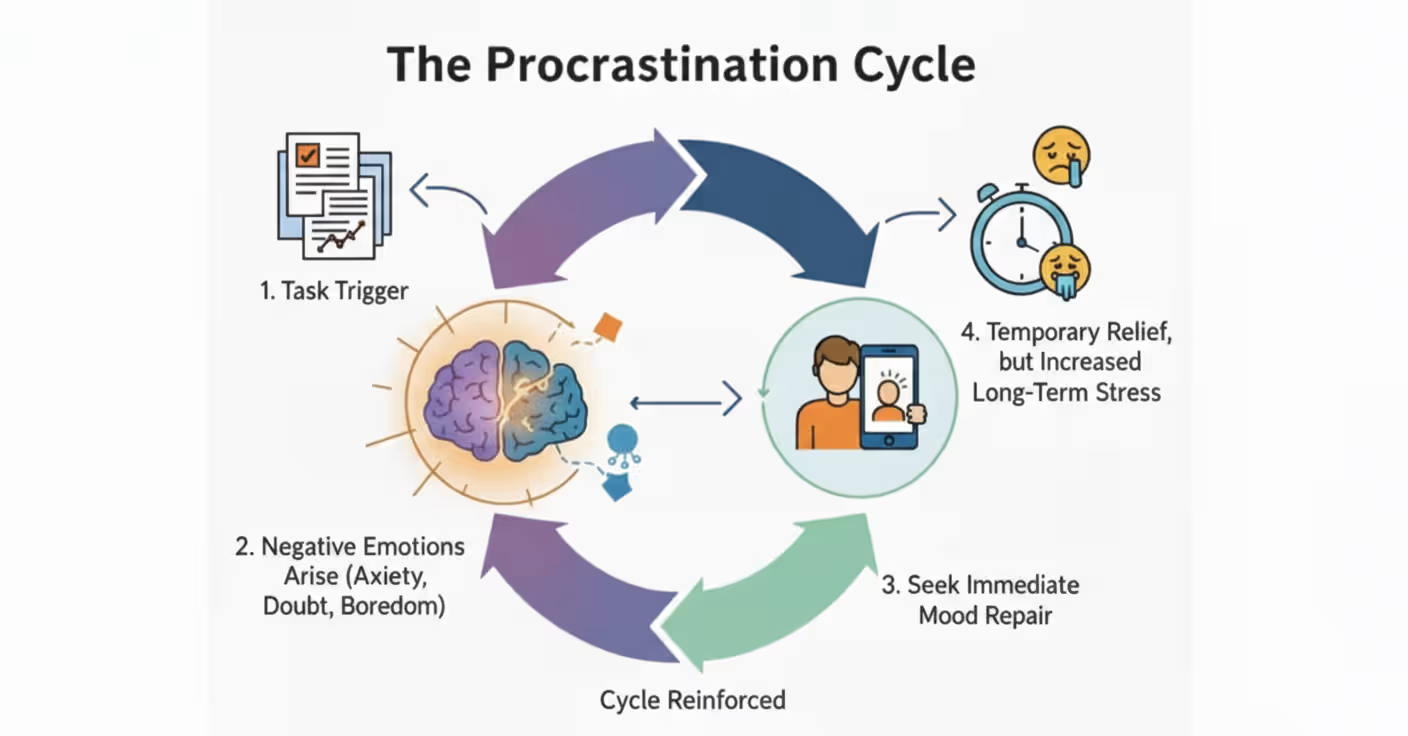
The first step toward breaking any cycle is to bring it into the light of conscious awareness. This requires moving beyond vague statements like "I procrastinate" or "I have anxiety" to a more granular, specific definition. The goal is to map out the pattern like a detective investigating a case. What are the precise triggers (internal or external)? What thoughts immediately follow the trigger? What emotions arise? What is the specific behavioral response? And finally, what is the short-term relief and the long-term consequence? For example, "procrastination" might be redefined as: "When faced with a complex work task (trigger), I think 'I can't do this perfectly' (thought), which makes me feel overwhelmed and anxious (emotion). I then open social media for an hour (behavior), which provides immediate distraction (short-term relief) but results in increased stress and a lower quality of work later (long-term consequence)." This level of specificity is crucial because it reveals the exact points in the cycle where intervention is possible. While most people believe they are self-aware, research from Forbes suggests only 10-15% of people truly possess self-awareness, highlighting the critical need for this foundational step.
The Science Behind the Cycle: How Brain Wiring Reinforces Patterns
Every time you repeat a pattern, you are strengthening a specific neural circuit in your brain. This process, often summarized by the Hebbian principle "neurons that fire together, wire together," makes the pattern more efficient and automatic over time. The brain's reward system, driven by the neurotransmitter dopamine, plays a significant role in cementing these cycles, especially in addiction and substance use. When a behavior provides a sense of pleasure or relief, dopamine is released, teaching the brain to seek out that behavior again. This creates a powerful feedback loop that can override rational decision-making. The cycle is not just a psychological phenomenon; it is a physical, neurological reality. Understanding this biological underpinning can foster self-compassion. You are not just fighting a bad idea; you are working to change the physical structure of your brain. This scientific perspective demystifies the struggle and frames it as a challenge of rewiring, not a failure of character.
Practicing Self-Awareness: Becoming the Observer, Not the Judge
True awareness is non-judgmental. The purpose of observing your patterns is not to criticize yourself but to gather data. This practice, central to mindfulness, involves stepping back and witnessing your thoughts, feelings, and urges without getting entangled in them. You become the observer of your internal experience rather than a participant in the drama. Techniques like journaling, meditation, and simple "check-ins" throughout the day can cultivate this skill. When you notice the urge to engage in your negative pattern, simply label it: "There is the thought that I need to check my phone," or "I am feeling the sensation of anxiety in my chest." This act of observing creates a sliver of space between stimulus and response—a space where you can eventually make a different choice. As mindfulness practices have become more widespread, with an estimated 200 to 500 million people engaging in them globally, their value as a tool for increasing self-awareness is increasingly recognized.
Disrupting the Momentum (Step 2: Intentional Interventions to Break the Pattern)
The "Pause and Pivot": Creating Space Before Reacting
Once you have developed awareness of your cycle's components, the next step is to actively disrupt its momentum. The most powerful initial intervention is the "pause." The space between the trigger and your automatic response is often infinitesimally small, but it is where your power lies. The goal is to consciously lengthen that space. When you notice a trigger, instead of immediately reacting, deliberately pause. Take one deep breath. Count to ten. Walk into another room. This simple act interrupts the automated neurological sequence. In that pause, you have the opportunity to pivot. A pivot is a conscious decision to do something—anything—different from the scripted response. It doesn't have to be the perfect, ideal new behavior yet. It just has to be different. The pause breaks the automaticity, and the pivot proves that a different outcome is possible.
Introducing Novelty: Small Shifts That Create Big Breaks
The brain's reliance on established patterns makes it susceptible to novelty. Introducing small, unexpected changes into your routine can help weaken the rigidity of your cycles. If your negative pattern involves sinking into the couch after work, try going for a five-minute walk immediately upon arriving home. If your cycle of negative self-talk is strongest in the morning, try listening to an uplifting podcast before you check your email. These small shifts act as pattern interrupts. They don't require monumental effort but are effective because they force your brain off its well-worn path. This strategy leverages the brain's preference for efficiency against itself; by making the old pattern slightly less convenient or accessible, you create an opening for a new behavior to take root.
Conscious Interventions: Choosing a New Response
With the space created by the pause and the pattern disrupted by novelty, you can begin to implement conscious interventions. This is where you intentionally choose a new response to replace the old one. This new response should be pre-determined and easily accessible. For example, if your pattern is to argue defensively when receiving critical feedback, your new, chosen response might be to say, "Thank you, I need some time to process that." If your cycle involves emotional eating, your new response might be to journal for five minutes about the feeling that's driving the urge. These interventions are a form of behavioral rehearsal. Initially, they will feel awkward and require significant mental effort. However, with repetition, these new chosen responses will begin to build their own neural pathways, becoming easier and more automatic over time, forming the foundation of a new, healthier cycle.
Building New Pathways (Step 3: Rewiring Your Brain Through Skill Development and Practice)
The Principles of Neuroplasticity: How Your Brain Can Change
The concept of neuroplasticity is the biological bedrock of lasting change. It confirms that the brain is not a static organ but a dynamic system that constantly adapts based on experience. When you learn a new skill, engage in a new thought pattern, or practice a new behavior, you are physically changing your brain's structure. You are encouraging the growth of new synapses and strengthening new circuits. Breaking a negative cycle is, therefore, a dual process: it involves the weakening of old, undesirable pathways through disuse (a process called synaptic pruning) and the strengthening of new, desirable pathways through focused repetition. This rewiring process takes time and consistency. As highlighted by Vo.Care Psychiatry and Behavioral Therapy, it takes an average of 66 days for a new behavior to become automatic, emphasizing that change is a marathon, not a sprint. Understanding neuroplasticity transforms the effort of change from a frustrating struggle into a constructive, brain-building project.
Developing Essential Skills for Lasting Change
Replacing a negative pattern requires more than just stopping the old behavior; it demands the cultivation of new skills to handle the underlying triggers and emotions more effectively. These skills often fall into several key categories of behavioral health:
- Emotional Regulation: Learning to identify, understand, and manage your emotional states without being overwhelmed. Techniques like deep breathing, mindfulness, and distress tolerance are central to this skill.
- Cognitive Restructuring: This involves challenging and changing the unhelpful thought patterns that fuel negative cycles. Based on principles from Cognitive Behavioral Therapy (CBT), it teaches you to identify cognitive distortions (like black-and-white thinking or catastrophizing) and replace them with more balanced and realistic thoughts. A meta-analysis has shown that cognitive restructuring and CBT are effective in improving outcomes for depression.
- Communication and Interpersonal Skills: Many negative cycles are rooted in relationship dynamics. Learning skills like assertive communication, boundary setting, and active listening can fundamentally alter these patterns.
- Problem-Solving Skills: Instead of resorting to an old, ineffective coping mechanism, developing a structured approach to identifying problems and brainstorming practical solutions builds self-efficacy and resilience.
Small Wins and Incremental Progress: The Path to Sustained Recovery
The process of building new skills and rewiring the brain is incremental. Attempting a radical, overnight transformation often leads to burnout and a return to the old pattern. The key to sustained recovery and change is to focus on small, consistent wins. If your goal is to overcome social anxiety, the first step isn't attending a large party; it's making eye contact with a cashier. If you're breaking a cycle of a sedentary lifestyle, the goal isn't running a marathon; it's walking for ten minutes a day. Each small success provides a dopamine release that reinforces the new behavior, making it more likely you'll repeat it. This approach builds momentum and self-confidence, creating a positive feedback loop that gradually replaces the old negative cycle. Celebrating this incremental progress is vital for maintaining motivation throughout the long-term journey of change.
Cultivating Your Support System (Step 4: Nurturing a Supportive Internal and External Environment)
The Inner Sanctuary: Fostering Self-Compassion and a Positive Inner Voice
Your internal environment—the landscape of your thoughts and self-talk—is the primary ground where new patterns must grow. A harsh inner critic can sabotage your efforts, interpreting setbacks as proof of failure and fueling feelings of shame that drive you back to the old cycle. Cultivating self-compassion is a non-negotiable part of the process. It involves treating yourself with the same kindness and understanding you would offer a good friend who is struggling. This means acknowledging your pain without judgment, recognizing that imperfection is a part of the shared human experience, and actively soothing and comforting yourself. This practice directly counters the negative self-talk that often perpetuates cycles of mental health disorders. Research increasingly supports the benefits of this approach; a study on post-traumatic stress found that individuals who worked to manage and reframe negative thoughts saw their negative mental health indices scores fall on average by 16%, suggesting that a compassionate, proactive inner response is highly beneficial.
Crafting Your External "Evolved Nest": Creating a Nurturing Environment
Just as a plant needs the right soil and light, your new patterns need a supportive external environment to flourish. This involves consciously curating your surroundings, relationships, and routines to reinforce your goals. This might mean "trigger-proofing" your environment, such as removing junk food from the house if you're breaking an emotional eating cycle, or installing a website blocker during work hours to combat procrastination. It also means evaluating your social circle. Are there people who enable your old patterns or drain your energy? It may be necessary to set boundaries or limit contact with them. Conversely, actively spend more time with people who support your growth, respect your goals, and model the kind of behavior you wish to emulate. This concept of an "evolved nest" suggests that our well-being is deeply connected to an environment that meets our core developmental and emotional needs.
Seeking and Utilizing External Support
Breaking deeply ingrained cycles, especially those related to trauma, addiction, or severe mental disorders, often requires more than self-help. Seeking external support is a sign of strength and a crucial strategic move. This support can take many forms:
- Professional Help: Therapists, counselors, and psychiatrists can provide evidence-based interventions like CBT and DBT, offer objective insights, and create a structured plan for recovery. This is particularly vital in the context of the current behavioral health crisis, where professional guidance can be life-changing. Despite the need, a significant gap exists, as one study indicated that 45% of individuals in the U.S. with a clinical-level mental problem do not seek professional help.
- Support Groups: Programs like AA, NA, or other peer-led groups provide a community of people with shared experiences. This sense of belonging combats the isolation that often accompanies negative cycles and offers practical advice and encouragement.
- Mentors and Trusted Friends: Sharing your journey with a trusted individual can provide accountability and emotional support. A mentor who has successfully navigated a similar path can offer invaluable wisdom and perspective.
Sustaining Your Transformation (Step 5: Building Resilience and Embracing Long-Term Growth)
Anticipating Challenges: Developing a Proactive Relapse Prevention Plan
Lasting change is not a linear path; it is a dynamic process with inevitable ups and downs. Setbacks and lapses are a normal part of breaking a long-standing cycle. Resilience is built not by avoiding these challenges, but by preparing for them. A proactive relapse prevention plan involves identifying your high-risk situations, early warning signs (both internal and external), and a clear list of coping strategies to use when you feel vulnerable. For cycles of addiction and substance use, this is a cornerstone of recovery. It's important to view relapse rates in the context of other chronic conditions; research shows that relapse rates for addiction are between 40% and 60%, similar to those for hypertension or asthma. This perspective normalizes setbacks, reframing them not as failures, but as opportunities to learn, refine your strategies, and strengthen your resolve. The plan should also include who you will contact for support if you do lapse.
Embracing the "Cycle of Cooperative Companionship"
As you break free from a negative, isolating cycle, you can begin to build a new, positive one: a "cycle of cooperative companionship." This concept, emerging from research in neurobiology and development, emphasizes our innate need for positive, reciprocal connection. Instead of a cycle of competition or detachment, this new cycle is fueled by supportive relationships, mutual encouragement, and shared growth. It involves actively giving and receiving support, celebrating others' successes, and being vulnerable in a safe community. This positive feedback loop strengthens your new identity and behaviors. By investing in healthy relationships and community, you create a powerful, self-reinforcing system that naturally pushes out the old, dysfunctional patterns and nurtures your continued development.
Continuous Learning and Adaptation
The person you are when you begin this journey is not the person you will be months or years later. Sustaining transformation requires a commitment to continuous learning and adaptation. Stay curious about yourself and your patterns. What works today might need adjustment tomorrow. This could involve reading books on psychology and personal development, listening to media like podcasts from experts, or attending workshops and other events that expand your skills and perspective. The world of mental health research is constantly evolving, offering new insights and interventions. By adopting a "growth mindset"—the belief that your abilities can be developed through dedication and hard work—you ensure that your process of change remains dynamic and responsive to your evolving needs and circumstances.
Celebrating Progress and Reinforcing Your New Identity
Finally, it is essential to acknowledge and celebrate your progress. The brain learns through reinforcement. When you take a moment to consciously appreciate how far you've come—recognizing the difficult moments you've navigated and the new skills you've applied—you reinforce the neural pathways associated with your new behaviors. This is not about celebrating perfection but about honoring effort and progress. Each time you choose the new response over the old one, you are casting a vote for your new identity. Over time, these small wins accumulate, and the identity of "someone who is breaking the cycle" solidifies into "someone who lives this new way." This shift in self-perception is the ultimate anchor for lasting change, making the new patterns feel authentic and natural.
Conclusion: Your Empowered Future
Reclaiming Your Autonomy and Designing Your Life
Breaking the cycle of negative patterns is one of the most empowering journeys an individual can undertake. It is a profound declaration of personal autonomy—a refusal to be defined by past programming, trauma, or ingrained habits. The five essential steps outlined in this article provide a comprehensive and actionable framework, but they are more than a mere set of instructions. They are a pathway to reclaiming the authorship of your life story. By moving through awareness, intervention, skill-building, support, and resilience, you dismantle the automated scripts that have limited your potential and begin to make conscious, deliberate choices that align with your deepest values and aspirations.
This process has implications that extend far beyond individual well-being, touching everything from the stability of the workforce to the broader response to the societal behavioral health crisis. Each person who successfully breaks a cycle contributes to a healthier collective, modeling the possibility of change and reducing the perpetuation of generational trauma and dysfunction. The journey is not always easy, and it requires sustained commitment, but the reward is immeasurable: a life not of reaction, but of intention; a future not dictated by the past, but designed by the present. Your empowered future begins with the first step of awareness and the courageous decision to begin.

.avif?alt=media&token=ea0595b3-79aa-4e53-b3aa-d9bf81c639eb)