In an age of unprecedented information flow and complexity, the ability to make clear, effective decisions is no longer just a desirable trait—it is an essential skill for personal and professional survival. From the minor choices that shape our daily routines to the major strategic pivots that define the future of an organization, the quality of our decisions dictates the quality of our results. Yet, for many, the process of deciding is fraught with anxiety, uncertainty, and a persistent fear of making the wrong choice. Research highlights this widespread challenge, with one study revealing that 85% of business leaders suffer from "decision distress," overwhelmed by the volume and velocity of choices they face.
This guide is designed to cut through that noise. It moves beyond simplistic advice to provide a comprehensive framework for understanding and mastering the art and science of decision-making. We will deconstruct the process, unmask the hidden psychological traps that derail our judgment, and equip you with practical strategies and advanced frameworks to navigate any choice with greater clarity and confidence. This is not about finding a magic formula for perfect outcomes; it's about developing a robust, reliable process that empowers you to make smarter, more defensible choices, learn from every result, and ultimately, take control of your future.
What is the meaning of decision-making?
At its core, decision-making is the cognitive process of selecting a course of action from among several alternative scenarios. It is a fundamental mental function that involves identifying a decision, gathering information, and assessing alternative resolutions. While often perceived as a singular moment of choice, true decision-making is a comprehensive process, not an isolated event. It begins with the recognition of a problem or an opportunity and culminates in a commitment to action, followed by a review of the consequences.
The definitions of decision-making often highlight its rational components. Management theorists describe it as a reasoning process based on the values, preferences, and beliefs of the decision-maker, aimed at achieving a desired outcome. This process requires a careful evaluation of information to weigh the potential benefits and drawbacks of various alternatives. However, a complete definition must also acknowledge the significant role of non-rational elements. Intuition, emotion, and subconscious biases are deeply intertwined in the process, influencing how we frame problems, what information we seek, and which choices feel most compelling. Therefore, a holistic understanding of decision-making acknowledges it as an integrated activity involving both conscious, deliberate analysis and subconscious, intuitive judgment.
Is good decision making an inborn skill, or is it a learned skill?
The question of whether effective decision-making is an innate talent or a developed competency is a classic nature versus nurture debate. Evidence suggests that the answer is a combination of both, but with a strong emphasis on the potential for learning and improvement. Certain personality traits, such as a higher tolerance for ambiguity or a natural inclination toward analytical thinking, may give some individuals an initial advantage. These traits can influence one's baseline comfort level with risk and uncertainty, which are inherent in many complex choices.
However, the overwhelming consensus in psychology and organizational behavior is that decision-making is fundamentally a learned skill. The core components of the decision-making process—problem definition, information gathering, alternative evaluation, and risk assessment—are all trainable. Like any other skill, from playing a musical instrument to learning a new language, decision-making improves with deliberate practice, structured feedback, and a conscious effort to learn from both successes and failures. By understanding established frameworks, recognizing cognitive biases, and developing self-awareness, anyone can significantly enhance their ability to make sound judgments. The most effective leaders and individuals are not necessarily those born with a "decision-making gene," but those who commit to the continuous process of refining their decision-making strategy and toolkit.
What are common decision-making traps and how can they be avoided?
Even the most intelligent and experienced individuals can fall prey to common decision-making traps, which are systematic patterns of error in judgment. These traps, often rooted in cognitive biases, can lead to suboptimal results. One of the most prevalent is the Confirmation Bias, the tendency to seek out and favor information that confirms pre-existing beliefs while ignoring contradictory evidence. To avoid this, one must actively play devil's advocate, deliberately seeking out dissenting opinions and data that challenge the initial hypothesis.
Another frequent trap is the Anchoring Bias, where an individual relies too heavily on the first piece of information offered (the "anchor") when making decisions. For example, the first price quoted in a negotiation can unduly influence the entire discussion. To mitigate this, it's crucial to view a problem from different perspectives and consciously avoid being locked into an initial frame of reference before exploring other information.
The Sunk Cost Fallacy is another powerful trap where individuals continue a course of action because they have already invested significant resources (time, money, effort), even when it's clear the decision is no longer viable. The key to avoiding this is to focus on future costs and benefits rather than past expenditures. Leaders in an organization must create a culture where changing course is seen as a sign of strength, not failure. Recognizing these and other biases is the critical first step toward developing a more objective and effective decision-making process.
Introduction: Why Mastering Decisions Matters More Than Ever
In today's fast-paced, hyper-connected world, the volume and complexity of the choices we face have grown exponentially. For individuals, this manifests as a constant stream of decisions about career paths, financial investments, and personal well-being. For any company or organization, the stakes are even higher; a single strategic decision can determine market leadership or obsolescence. Mastering the decision-making process is therefore no longer a soft skill but a critical competency for navigating modern life and leadership.
Decision-making models provide structured ways to approach this complexity. For example, a SWOT (Strengths, Weaknesses, Opportunities, Threats) analysis is a powerful framework used in business strategy. A company might use it to decide whether to launch a new product. By systematically listing internal strengths (e.g., strong brand recognition) and weaknesses (e.g., limited production capacity) alongside external opportunities (e.g., growing market demand) and threats (e.g., new competitor), leaders can make a more informed and holistic choice. Similarly, a decision tree can be applied to map out potential outcomes of a series of choices. This model helps an organization visualize the likely results of different paths, assigning probabilities and potential values to each branch, making it invaluable for decisions involving uncertainty and sequential steps, such as deciding on a capital investment project.
The Daily Impact of Your Choices
The significance of decision-making extends far beyond the boardroom. Every day, each of us makes hundreds of choices, most of them small and subconscious. What to eat for breakfast, which route to take to work, how to respond to an email—these seemingly minor decisions create a cumulative effect. They shape our habits, manage our energy, and ultimately build the foundation of our larger life outcomes. A single poor dietary choice has a negligible impact, but a pattern of them can lead to significant health issues. Likewise, a consistent process of making thoughtful, value-aligned choices, even on a small scale, compounds over time to produce powerful positive results in our careers, relationships, and overall well-being. Recognizing the profound daily impact of our choices is the first step toward treating the decision-making process with the attention it deserves.
The Promise: A Path to Smarter, More Confident Decision-Making
The promise of this guide is not to offer a shortcut to perfect decisions—for in a world of uncertainty, no such thing exists. Instead, it offers a clear, actionable path toward developing a smarter, more confident approach to the process of deciding itself. By understanding the landscape of decision-making, decoding your own cognitive tendencies, and mastering a structured process, you can fundamentally change your relationship with choice. You will learn to move from a state of reactive anxiety to one of proactive clarity. This journey involves building a repeatable methodology that reduces the influence of debilitating biases, leverages both logic and intuition appropriately, and transforms every outcome—good or bad—into a valuable learning opportunity. The ultimate goal is to equip you with the tools and mindset to face any decision, simple or complex, with the assurance that you are engaging in a high-quality process designed for the best possible results.
Understanding the Decision Landscape: What Makes Decisions Challenging?
Before one can improve their decision-making, it is essential to understand why making choices can be so inherently difficult. The challenges are not merely a matter of willpower or intelligence; they are woven into the very fabric of how we process information and interact with an uncertain world. The modern environment exacerbates these challenges with an overabundance of information, a multitude of alternatives, and an accelerated pace that often demands immediate action. This combination creates a fertile ground for stress, indecision, and error. Acknowledging this complex landscape is the first step toward building a strategy to navigate it effectively.
The Nature of a Decision: Beyond a Simple Choice
A true decision is more than a simple choice between two clear options, like choosing between tea or coffee. It typically involves three key components: uncertainty, consequences, and alternatives. First, nearly every significant decision carries an element of uncertainty. We rarely have complete information about the future or the exact outcome of our actions. Second, meaningful decisions have consequences. These results affect not only ourselves but potentially our families, colleagues, or the broader organization. The weight of these consequences can create significant psychological pressure. Third, a decision implies the existence of multiple viable alternatives. If there is only one possible path, there is no decision to be made. The process involves identifying and evaluating these different courses of action, each with its own set of potential outcomes and trade-offs.
Common Roadblocks: Why Decisions Feel Hard
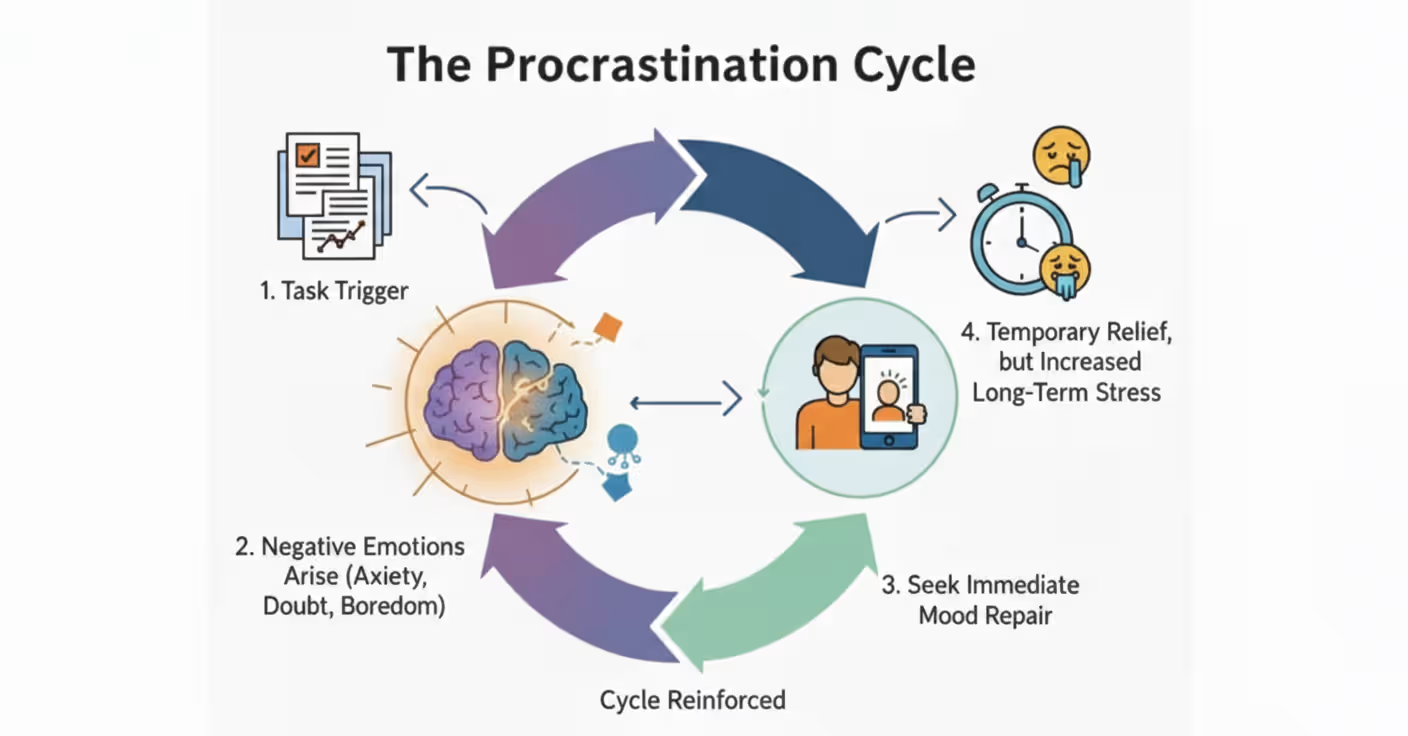
Several common roadblocks can make the process of deciding feel arduous and overwhelming. One of the most significant is information overload. While access to information is valuable, too much data can be paralyzing, making it difficult to distinguish signal from noise. This can lead to "analysis paralysis," where the fear of missing a crucial piece of information prevents any decision from being made at all.
Another roadblock is fear of regret, also known as "buyer's remorse" on a larger scale. This is the anxiety that a different choice would have produced a better outcome. This fear can lead to procrastination or an endless search for a "perfect" option that does not exist. Finally, conflict of values presents a major challenge. Decisions often force us to prioritize one value over another—for example, choosing between a high-paying job that demands long hours (valuing financial security) and a lower-paying role with better work-life balance (valuing personal time). Navigating these internal and external conflicts is a central difficulty in the decision-making journey.
Decoding Your Decision-Making DNA: Self-Awareness for Better Choices
Effective decision-making begins with introspection. Just as an athlete must understand their physical strengths and weaknesses, a decision-maker must understand their cognitive and emotional tendencies. Our "decision-making DNA" is a unique blend of our innate cognitive style, learned habits, emotional responses, and core values. Without this self-awareness, we are likely to be driven by hidden biases and default patterns that may not serve our best interests. By decoding these personal elements, we can begin to approach choices more consciously, leveraging our strengths and actively compensating for our weaknesses to improve the quality of our results.
Your Innate Cognitive Style: Rational vs. Intuitive Decision-Making Styles
Individuals generally lean toward one of two primary cognitive styles: rational or intuitive. The rational style is analytical, logical, and step-by-step. A person with this preference focuses on gathering objective facts, weighing evidence systematically, and using frameworks to arrive at a defensible conclusion. This approach excels in situations where data is abundant, the variables are well-understood, and there is time for careful deliberation.
Conversely, the intuitive style relies on gut feelings, patterns recognized from past experience, and holistic judgments. An intuitive decision-maker processes information in a more synthesized, non-linear fashion, often arriving at a conclusion without being able to articulate every step of the logical process. This style is particularly effective in complex, ambiguous, or time-sensitive situations where hard data is scarce. Neither style is inherently superior; the most adept decision-makers learn to cultivate both, applying a rational process to structure the problem and using their intuition to evaluate alternatives and make the final choice.
Are You a Maximizer or a Satisficer? Understanding Your Pursuit of Perfection
Another critical dimension of your decision-making DNA is whether you tend to be a "maximizer" or a "satisficer." This concept, developed by psychologist Herbert Simon, describes two different approaches to evaluating choices. A maximizer strives to make the absolute best possible choice. They feel compelled to examine every single alternative, seeking to ensure they are not missing out on a better option. While this drive can lead to excellent outcomes, it often comes at a high cost of time, energy, and stress, and can result in chronic dissatisfaction and regret.
A satisficer, on the other hand, seeks an option that is "good enough." They identify their core criteria and select the first alternative that meets those standards. This approach is far more efficient and generally leads to greater happiness and contentment with the final decision. For day-to-day choices, adopting a satisficing strategy is often more effective. For high-stakes, irreversible decisions, a more maximizing approach may be warranted, but it's crucial to know when to stop searching and commit to a choice.
The Role of Emotions and Your Value System in Deciding
Decisions are rarely, if ever, purely logical exercises. Emotions play a profound and often constructive role. Positive emotions can broaden our thinking and foster creativity in generating alternatives, while negative emotions like fear can serve as important signals of risk. The key is not to suppress emotions but to develop emotional intelligence—the ability to recognize, understand, and manage them. This allows us to ask critical questions: "Is this fear a rational warning, or is it an irrational anxiety?" or "Is this excitement based on solid evidence, or is it wishful thinking?"
Underpinning our emotional responses is our personal value system. Our core values act as an internal compass, guiding our choices toward what we deem most important. A decision that aligns with our values feels right and is easier to commit to, while one that conflicts with them can cause persistent internal dissonance. A crucial part of the decision-making process is to explicitly identify the values at stake and use them as a primary criterion for evaluating alternatives.
The Core Process: A Step-by-Step Guide to Smarter Decisions
While individual styles vary, a structured, systematic process provides a powerful scaffold for any significant decision. Following a clear sequence of steps helps ensure that all critical aspects of a problem are considered, reduces the influence of impulse and bias, and creates a transparent, defensible logic for the final choice. This methodical approach transforms decision-making from a chaotic art into a manageable science. The following seven steps represent a comprehensive and adaptable framework that can be applied to personal dilemmas, group deliberations within a company, and complex strategic challenges faced by leadership.
Step 1: Clearly Define the Problem or Opportunity
The most common mistake in decision-making is solving the wrong problem. Before jumping to solutions, it is crucial to clearly articulate the issue at hand. This step involves asking probing questions: What is the actual goal we are trying to achieve? What constitutes success? What are the constraints and boundaries of this decision? For example, a team struggling with missed deadlines might initially define the problem as "needing to work harder." A clearer definition might be "identifying and resolving the bottlenecks in our current workflow." This reframing opens up a much wider and more productive range of potential solutions. A well-defined problem statement acts as a guiding star for the entire decision-making process.
Step 2: Gather Relevant Information (Become a Savvy Detective)
With a clear problem defined, the next step is to gather relevant information. The goal is to collect objective data, facts, and diverse perspectives that illuminate the situation. This is not about amassing every piece of data available, which can lead to analysis paralysis, but about being a savvy detective focused on high-quality, relevant intelligence. Key tasks include identifying what you know, what you don't know, and where you can find the missing information. This may involve market research, consulting experts, analyzing historical data, or soliciting input from stakeholders. A critical part of this stage is evaluating the credibility of your sources and distinguishing between objective facts and subjective opinions.
Step 3: Identify and Explore Alternatives (Expand Your Horizons)
Many decision-makers limit their options by settling on the first one or two alternatives that come to mind. A robust process requires a conscious effort to expand the field of choices. This is a creative phase that benefits from brainstorming and open-mindedness. Challenge the assumption that there are only two opposing options (an "either/or" choice). Ask questions like, "What if we did nothing?" or "What other ways could we achieve our goal?" In a group setting, encouraging all members to contribute ideas without initial judgment can uncover innovative solutions that might otherwise have been missed. The objective is to generate a diverse set of viable alternatives before moving on to evaluation.
Step 4: Evaluate Alternatives: Weighing the Evidence
Once a range of alternatives has been identified, the next step is to evaluate them systematically. This involves assessing each option against the criteria established in Step 1. A simple and effective tool for this is a pros and cons list, but more complex decisions may require more sophisticated frameworks. A decision matrix, for example, allows you to score each alternative across several weighted criteria (such as cost, implementation time, and alignment with strategy). The goal is to objectively analyze the potential outcomes, risks, and benefits associated with each choice. This step brings analytical rigor to the process, moving beyond gut feelings to a more evidence-based comparison of the available paths.
Step 5: Make Your Choice (The Moment of Truth)
After a thorough evaluation, the moment arrives to make the final decision. If the previous steps have been followed diligently, this choice should be the logical conclusion of your analysis. It should be the alternative that best solves the defined problem and aligns with your values and goals. It is important to acknowledge that even with a great process, there may not be a single "perfect" choice. Often, the decision involves selecting the best option among several imperfect alternatives. At this stage, confidence comes not from certainty about the outcome, but from certainty in the quality of the process that led to the decision.
Step 6: Implement and Act (Translate Choice into Positive Action)
A decision without action is merely a thought. The implementation phase is where the chosen alternative is translated into a concrete plan. This step is critical and often overlooked. It requires defining who is responsible for what, setting clear timelines, allocating necessary resources, and communicating the decision to all relevant stakeholders. A brilliant decision with poor execution will inevitably lead to poor results. Effective leadership involves not only making the right choice but also ensuring that the organization or individual has the capacity and commitment to carry it out successfully. This is the bridge between deciding and achieving.
Step 7: Review and Learn (The Essential Feedback Loop)
The final step in the process is to review the results of your decision and its implementation. This crucial feedback loop is what turns experience into wisdom. After a reasonable period, assess the outcome: Did the decision achieve its intended goal? What were the unintended consequences? What went well during implementation, and what could be improved? This reflective practice is vital for refining your decision-making skills over time. It allows you to learn from mistakes, replicate successes, and adapt your strategy for future choices. An organization that builds this review into its culture fosters an environment of continuous improvement and smarter decision-making at all levels.
Beyond the Steps: Advanced Strategies for Confident Decision-Making
While a structured, seven-step process provides a solid foundation, achieving true mastery requires moving beyond the basics. Advanced strategies involve developing a deeper awareness of the subtle psychological forces at play and leveraging more sophisticated mental tools to navigate complexity. This means learning to unmask the hidden biases that color our judgment, employing powerful frameworks to gain new perspectives, and understanding when to trust our highly-tuned intuition. For those in leadership roles, it also means mastering the art of guiding a group toward a collective, high-quality decision.
Unmasking Cognitive Biases: The Hidden Influences on Your Choices
Cognitive biases are mental shortcuts (heuristics) that our brains use to make sense of the world quickly. While often useful, they can lead to systematic errors in judgment. Beyond common traps like confirmation bias, dozens of other biases can subtly distort the decision-making process. The Availability Heuristic, for instance, causes us to overestimate the likelihood of events that are more recent or memorable in our minds. The Framing Effect shows that how a choice is presented (e.g., as a gain or a loss) can dramatically alter our preference, even if the underlying options are identical. The first step to mitigation is awareness. By actively learning about these biases, you can begin to spot them in your own thinking and create "circuit breakers"—like seeking outside perspectives or rephrasing the problem—to counteract their influence.
Leveraging Mental Models and Frameworks for Deeper Insight
Mental models are simplified representations of how things work in the real world. Having a diverse toolkit of these models allows you to look at a single problem from multiple angles, revealing insights that would be invisible from a single perspective. For example, using the "Inversion" model (thinking about a problem in reverse) can be incredibly powerful. Instead of asking "How can we succeed?" you ask "What could cause us to fail?" This often uncovers critical risks that were previously overlooked. Other frameworks, like the Eisenhower Matrix (urgent/important), help prioritize tasks and decisions, while Second-Order Thinking pushes you to consider the long-term consequences of a decision, not just the immediate results. Consistently applying these models adds depth and rigor to your analysis of alternatives.
The Art of Intuitive Decision-Making: When to Trust Your Gut
While a rational process is crucial, intuition—or "gut feeling"—should not be dismissed. Expert intuition is not magic; it is a highly developed form of pattern recognition built on years of experience and learning. Your brain subconsciously processes subtle cues and connects them to past outcomes, delivering the result as an intuitive feeling. The key is to know when to trust it. Intuition is most reliable in environments where you have deep expertise and receive regular, clear feedback. A seasoned firefighter's gut feeling about a building's stability is trustworthy; an amateur's gut feeling about the stock market is not. The best strategy is to use your intuition to generate hypotheses or as a final check on a rational analysis, but not as a substitute for it.
Navigating Group Decision-Making: Collaboration and Consensus
Making decisions in a group introduces new layers of complexity, from interpersonal dynamics to organizational politics. A primary challenge is Groupthink, a phenomenon where the desire for harmony or conformity in a group leads to an irrational or dysfunctional decision-making outcome. To combat this, leaders must foster an environment of psychological safety where all members feel comfortable voicing dissenting opinions. Techniques like the Delphi method (where experts provide anonymous input) or appointing a "devil's advocate" whose official role is to challenge the prevailing consensus can ensure that alternatives are rigorously debated. The goal of group decision-making is not always consensus, but rather a well-considered choice that has the commitment of the team members responsible for its implementation.
Practical Tools and Habits for Everyday Decision Excellence
Mastering decision-making is not about a one-time transformation but about cultivating a set of consistent habits and using practical tools that embed smart practices into your daily routine. Just as physical fitness requires regular exercise, "decision fitness" is built through consistent, deliberate practice. These tools are not complex or time-consuming; they are simple yet powerful methods for bringing more clarity, reflection, and intentionality to the choices you make every day, creating a virtuous cycle of improvement.
The Decision Journal: A Personal Tool for Reflection and Growth
One of the most effective habits for improving your decision-making is keeping a decision journal. Before making a significant choice, take a few minutes to write down the situation, the alternatives you considered, the choice you made, and, most importantly, the reasoning behind it and what you expect the outcome to be. Then, at a later date, revisit the entry and document the actual results. This simple act of writing accomplishes several things: it forces you to clarify your thinking, it provides an honest record free from hindsight bias, and it creates an invaluable personal database of your decision-making patterns. Over time, you will see where your reasoning was strong, where your biases crept in, and how you can adjust your process for better future results.
Seeking Expert Input: The Value of Diverse Expertise and Mentorship
No one has all the answers. A core habit of excellent decision-makers is knowing when and how to seek input from others. This goes beyond casual advice-seeking. It involves strategically identifying individuals with relevant expertise or different perspectives who can challenge your assumptions and fill in your knowledge gaps. A mentor who has faced similar choices can provide invaluable guidance on process and potential pitfalls. In an organization, this means breaking down silos and consulting members from different departments. The key is to approach these conversations not to seek validation for your own view, but with genuine curiosity and a desire to see the decision from all possible angles before making a final commitment.
Conclusion
The journey to becoming a better decision-maker is a continuous process of learning, reflection, and deliberate practice. It is not about eliminating uncertainty or achieving perfect outcomes, but about developing a robust and reliable strategy for navigating the complexities of choice with clarity and confidence. By understanding the foundational meaning of decision-making, recognizing it as a learned skill, and actively avoiding common psychological traps, you build the essential groundwork for improvement.
The core of this journey lies in a structured, multi-step process: defining the problem with precision, gathering relevant information, exploring a wide range of alternatives, evaluating them systematically, committing to a choice, executing it effectively, and, crucially, reviewing the results to learn and adapt. This methodology provides a powerful defense against impulsive choices and hidden biases. To elevate this skill further, advanced strategies—such as leveraging mental models, understanding the appropriate role of intuition, and navigating group dynamics—add layers of sophistication and insight.
Ultimately, mastering this skill is about cultivating "decision fitness." Simple habits, such as keeping a decision journal to track your process and outcomes, and actively seeking diverse expertise, transform theory into consistent practice. By embracing decision-making as a trainable discipline, you empower yourself to move from a state of anxiety and indecision to one of strategic confidence. The results will not only be better choices but a greater sense of agency over your personal and professional trajectory.