.avif?alt=media&token=a2d81519-3f9d-4d6e-9db3-2acd6fc27951)
How to reduce stress levels quickly?
In a world saturated with digital alerts, professional demands, and personal responsibilities, the feeling of being overwhelmed is an increasingly common experience. The relentless pace of modern life often leaves little room for extensive self-care routines, creating a pressing need for effective, immediate solutions. Stress, in its acute form, can feel like a sudden storm, clouding judgment and hijacking our sense of control. This article serves as a practical guide to navigating those storms. It moves beyond the abstract concept of stress management and provides a toolkit of scientifically-grounded, actionable techniques designed to deliver calm in minutes, or even seconds. By understanding and utilizing these methods, you can reclaim your equilibrium, interrupt the cycle of anxiety, and build a more resilient foundation for your overall mental health.
The Modern Predicament: Constant Stressors
 Our bodies' stress response, designed for acute physical threats, is now constantly activated by the chronic, psychological stressors of modern life.
Today's environment is a fertile ground for stress. The boundaries between work and home have blurred, digital news cycles deliver a constant stream of worrying information, and societal pressures mount from all directions. These external factors are compounded by internal pressures, such as family responsibilities, financial concerns, and personal aspirations. This continuous barrage of stimuli keeps the body's stress response system on high alert. Unlike the acute, physical threats our ancestors faced, modern stressors are often chronic and psychological. This sustained activation of our internal alarm system can lead to a host of negative symptoms, impacting everything from our sleep quality to our interpersonal relationships. Identifying these personal triggers—be it a looming deadline, a difficult conversation, or a crowded commute—is the first step toward effectively managing their impact.
The Power of a Moment: Why "Minute" Stress Reduction Matters
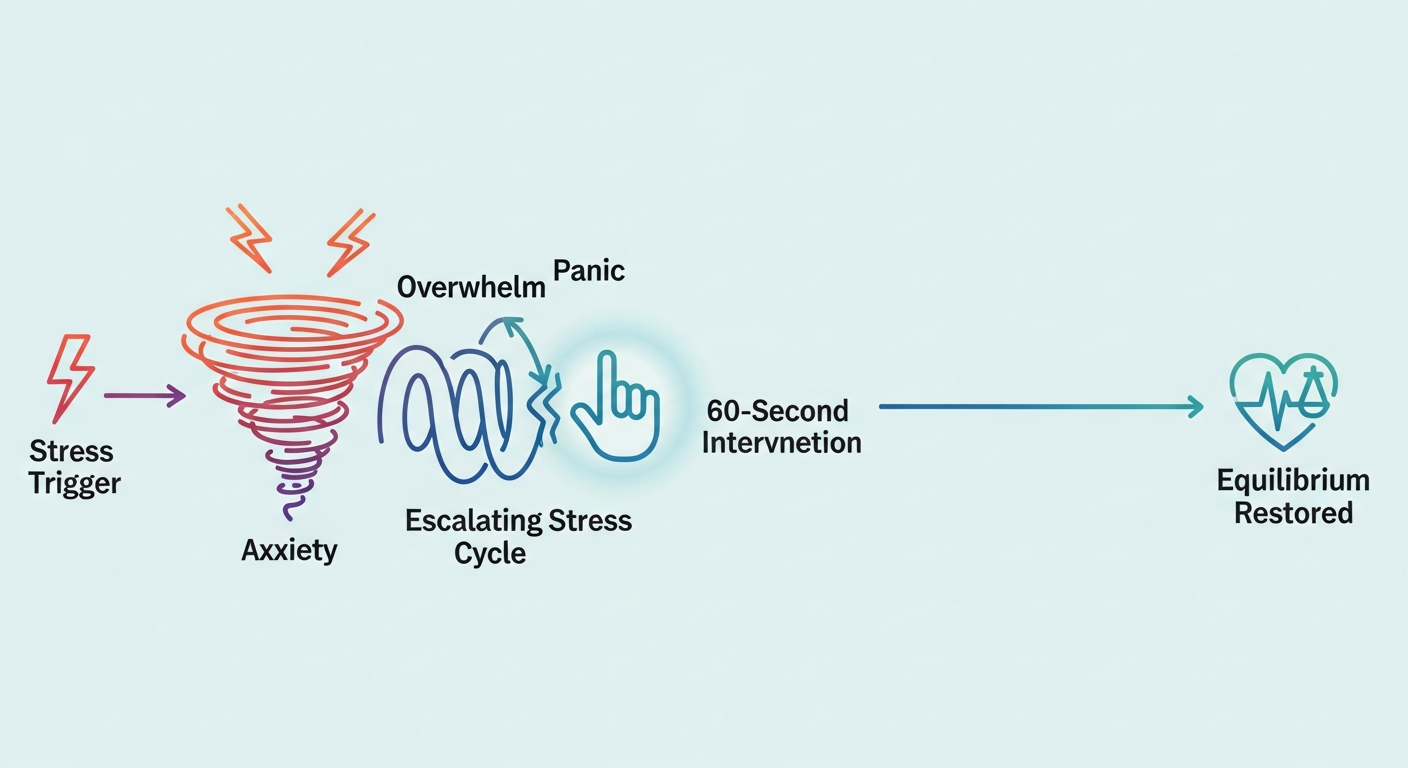 A one-minute intervention can act as a 'circuit breaker,' interrupting the stress escalation cycle before it leads to prolonged anxiety or panic.
While long-term strategies like therapy and consistent exercise are vital for robust mental health, they are not always accessible in the precise moment stress strikes. This is the critical gap that "minute" stress reduction techniques are designed to fill. Their power lies in their accessibility and immediacy. By taking just 60 seconds to intentionally shift your physiological and psychological state, you can interrupt the escalating cycle of a stress reaction. This brief pause acts as a circuit breaker, preventing an acute stressor from spiraling into prolonged anxiety or a full-blown panic response. These micro-interventions are not about eliminating stress entirely—an impossible and undesirable goal—but about managing your response to it in real-time, empowering you to navigate challenges with greater clarity and composure.
What You'll Discover: A Toolkit for Immediate Calm
This article provides a comprehensive toolkit of proven techniques for rapid stress reduction. We will explore methods grounded in physiology, mindfulness, physical movement, and cognitive psychology. You will learn specific breathing exercises that can instantly calm your nervous system, mindfulness practices to ground you in the present moment, quick physical releases to dissipate stored tension, and cognitive reframing tools to change your mental perspective on a stressor. Each technique is designed to be performed in a short amount of time, making them practical for use at your desk, in a crowded space, or during a brief break. By the end, you will have a versatile set of skills to manage acute stress whenever and wherever it arises, fostering a greater sense of control over your well-being.
The Science of Swift Serenity: How Minute Techniques Work
The effectiveness of minute stress reduction techniques is not based on wishful thinking but on their ability to directly influence the body's intricate neurobiological systems. These methods work by intentionally shifting the autonomic nervous system from a state of high alert to one of rest and recovery. Understanding this underlying science demystifies the process and reinforces the power you have to regulate your own physiological state.
Understanding the "Fight or Flight" Stress Response
When your mind perceives a threat—whether it's a real physical danger or a psychological stressor like a critical email from your boss—it triggers the sympathetic nervous system (SNS). This is the "fight or flight" response, an ancient survival mechanism. The brain's amygdala sends a distress signal to the hypothalamus, which acts as the command center. This initiates a cascade of hormonal and physiological changes. The adrenal glands release adrenaline and cortisol, the body's primary stress hormones. Consequently, your heart rate accelerates, your blood pressure rises, your breathing becomes shallow and rapid, and your muscles tense up. Blood is shunted away from non-essential functions like digestion and toward your major muscle groups, preparing you to either confront the threat or flee from it. While essential for short-term survival, chronic activation of this system due to persistent modern triggers can lead to significant wear and tear on the body and mind.
Triggering the Relaxation Response: Your Body's Natural Antidote
Fortunately, the body has a built-in counterbalance to the fight or flight response: the parasympathetic nervous system (PNS). The PNS is responsible for the "rest and digest" state, promoting relaxation, recovery, and conservation of energy. The goal of minute stress reduction techniques is to consciously activate this system. Dr. Herbert Benson, a pioneer in mind-body medicine, termed this activation the "Relaxation Response." Techniques like deep breathing, meditation, and mindfulness act as direct inputs to engage the PNS. For example, slow, deep breaths stimulate the vagus nerve, a major component of the PNS that runs from the brainstem to the abdomen. Vagal stimulation sends signals back to the brain, effectively telling it that the threat has passed and it's safe to calm down. This conscious intervention breaks the feedback loop of the stress response, allowing the body to return to a state of equilibrium, or homeostasis.
The Physiological Impact: Heart Rate, Blood Pressure, and Muscles
Activating the relaxation response has immediate and measurable physiological effects that directly counteract the symptoms of stress. As the parasympathetic nervous system takes over, the release of stress hormones like cortisol and adrenaline is reduced. This leads to a decrease in heart rate, allowing the cardiovascular system to operate under less strain. Blood vessels, which constrict during the stress response, begin to dilate, leading to a reduction in blood pressure. Breathing deepens and slows, increasing oxygen supply to the brain and body, which can enhance mental clarity. Simultaneously, the tension held in skeletal muscles begins to release. Shoulders drop, jaws unclench, and a feeling of physical ease spreads through the body. These tangible physical shifts are not merely pleasant side effects; they are the direct result of down-regulating the body's stress machinery, demonstrating the profound connection between the mind and body.
Breathe Your Way to Instant Peace
Among all the tools available for stress reduction, conscious control of the breath is arguably the most powerful and accessible. It requires no equipment, can be done anywhere, and its effects are almost immediate. Breathing techniques work by directly influencing the autonomic nervous system, serving as a manual override to switch from a state of stress to a state of calm.
Deep Breathing: The Foundation of Calm
The most fundamental breathing practice is deep, diaphragmatic breathing, often called "belly breathing." When we are stressed, our breathing tends to become shallow and rapid, originating from the chest. This pattern signals danger to the brain and perpetuates the stress cycle. Deep breathing reverses this. By engaging the diaphragm—a large muscle at the base of the lungs—you take fuller, slower breaths that maximize oxygen exchange and stimulate the vagus nerve. This simple act sends a powerful signal of safety to your nervous system, initiating the relaxation response. Mastering this foundational technique provides a reliable anchor you can return to in any stressful situation. It is the cornerstone upon which other, more specific breathing exercises are built.
The 4-7-8 Breath for Rapid Relaxation
Developed by Dr. Andrew Weil, the 4-7-8 breathing technique is a powerful tranquilizer for the nervous system. It is particularly effective for managing acute anxiety and can be a useful tool for those who have trouble with sleep. The specific ratio of inhalation, hold, and exhalation forces the body into a state of deep relaxation.
How to Practice:
- Sit or lie down in a comfortable position. Place the tip of your tongue against the ridge of tissue just behind your upper front teeth and keep it there throughout the exercise.
- Exhale completely through your mouth, making a whoosh sound.
- Close your mouth and inhale quietly through your nose to a mental count of four.
- Hold your breath for a count of seven.
- Exhale completely through your mouth, making a whoosh sound, for a count of eight.
- This completes one breath cycle. Inhale again and repeat the cycle three more times for a total of four breaths.
The prolonged exhalation is key, as it fully expels carbon dioxide and activates the parasympathetic nervous system.
Box Breathing for Focus and Stability
Box breathing, also known as four-square breathing, is a technique used by Navy SEALs, athletes, and professionals to maintain calm and focus under pressure. Its symmetrical structure is easy to remember and helps to regulate the nervous system without causing drowsiness, making it ideal for use during the workday or before a stressful event.
How to Practice:
- Find a comfortable seated position with your back straight.
- Exhale all the air from your lungs to a count of four.
- Inhale slowly and deeply through your nose for a count of four.
- Hold your breath for a count of four.
- Exhale slowly through your mouth or nose for a count of four.
- Hold your breath with empty lungs for a count of four.
- This completes one cycle. Repeat for 1-2 minutes or until you feel your mind and body stabilize.
Visualizing drawing a square as you breathe can enhance the focusing effect of this practice.
Belly Breathing for Grounding and Relaxation
While foundational, a focused practice on belly breathing is a technique in itself, designed to deeply ground you in your body and promote profound relaxation. It's an excellent way to check in with your physical state and release tension you may not have been aware of.
How to Practice:
- Lie on your back with your knees bent or sit comfortably in a chair.
- Place one hand on your chest and the other on your belly, just below your rib cage.
- Inhale slowly and deeply through your nose, focusing on allowing your belly to rise as your lungs fill with air. The hand on your chest should remain relatively still.
- Feel the expansion in your abdomen as the diaphragm contracts and moves downward.
- Pause briefly at the top of the inhale.
- Exhale slowly through your mouth or nose, allowing your belly to fall as the air leaves your lungs. Gently use your hand to press the remaining air out.
- Continue for 5-10 breath cycles, focusing entirely on the sensation of your belly rising and falling.
Mindful Moments: Grounding Yourself in Seconds
Mindfulness is the practice of paying attention to the present moment on purpose, without judgment. When stress pulls your mind into worried thoughts about the future or regrets about the past, a brief moment of mindfulness can act as a powerful anchor, returning you to the stability of the here and now. These micro-mindfulness exercises are designed to be completed in under a minute.
The 60-Second Mindfulness Scan: Engaging Your Senses
This technique, often called the 5-4-3-2-1 method, works by systematically drawing your attention away from internal stress and redirecting it to the external environment through your senses. It is exceptionally effective for interrupting a spiral of anxious thoughts.
How to Practice:
- Pause wherever you are and take one deep breath.
- Look around you and silently name five things you can see. Notice their color, shape, and texture. (e.g., "I see a blue pen, a textured wall, a green plant...")
- Listen and silently name four things you can hear. Pay attention to sounds both near and far. (e.g., "I hear the hum of the computer, a bird outside, my own breathing...")
- Feel and silently name three things you can feel with your body. (e.g., "I feel the chair supporting my back, the fabric of my shirt, the floor under my feet...")
- Smell and silently name two things you can smell. If you can't identify two distinct smells, simply notice the quality of the air. (e.g., "I smell coffee, the faint scent of soap...")
- Taste and silently name one thing you can taste. This could be the lingering taste of your last meal, or simply the sensation of your own tongue.
Anchoring with an Object or Sound: A Quick Mental Reset
This micro-meditation uses a single point of focus to quiet the mind. It helps to train your attention and provides a simple, concrete anchor when your thoughts feel chaotic.
How to Practice:
- Choose an anchor. This can be a small object on your desk (a stone, a pen), a specific sound in your environment (the ticking of a clock, the whir of a fan), or even the sensation of your own breath entering and leaving your nostrils.
- Set a timer for 60 seconds or simply estimate the time.
- Focus all your attention on your chosen anchor. If using an object, notice every detail: its color, weight, texture, and temperature. If using a sound, simply listen to it without labeling or judging it.
- When your mind inevitably wanders—and it will—gently and without criticism, guide your attention back to your anchor.
- Repeat this process of noticing distraction and returning your focus until the minute is up.
Micro-Gratitude Pause: Shifting Perspective with Thanks
Stress and anxiety often narrow our focus onto what is wrong or threatening. A micro-gratitude pause intentionally counteracts this by broadening your perspective to include what is positive, however small. This cognitive shift can quickly alter your emotional state.
How to Practice:
- Pause for 30 to 60 seconds.
- Take one deep breath to center yourself.
- Quickly bring to mind three specific things you are grateful for right now. They do not need to be monumental.
- Examples could include: "I am grateful for this warm cup of tea," "I am grateful for the comfortable chair I'm sitting in," or "I am grateful for the five minutes of quiet I have right now."
- For each item, try to feel the genuine emotion of appreciation for a few seconds before moving to the next.
Mini Body Scan: Rapid Tension Spotting and Releasing
We often hold physical tension in our bodies without realizing it, which contributes to our overall sense of stress. A mini body scan is a quick way to identify and release this stored tension.
How to Practice:
- Sit or stand in a comfortable position and close your eyes if you can.
- Take one deep belly breath in and out.
- Starting at the top of your head, quickly scan your attention down through your body.
- Briefly notice your forehead. Is it furrowed? Intentionally soften it.
- Notice your jaw. Is it clenched? Allow it to go slack.
- Notice your shoulders. Are they hunched up by your ears? Let them drop down and back.
- Notice your hands. Are they in tight fists? Open them and let your fingers relax.
- Finally, notice your stomach. Is it tight? Breathe into your belly and let it soften.
- This entire process can be completed in under 60 seconds.
Quick Physical Release: Letting Go of Tension
Stress is not just a mental or emotional experience; it's a physical one. The hormones released during the "fight or flight" response prepare the body for intense physical exertion. When that exertion doesn't happen, the energy and tension can remain trapped in the body. Quick physical releases help to dissipate this stored energy, providing an immediate sense of relief.
The Desk Stretch & Shake Out: Instant Movement for Stuck Energy
For those who spend much of their day sitting, tension often accumulates in the neck, shoulders, and back. This simple routine, inspired by basic yoga principles, can be done without leaving your chair.
How to Practice:
- Neck Rolls: Gently drop your chin to your chest. Slowly roll your right ear toward your right shoulder, hold for a breath, then return to center. Repeat on the left side.
- Shoulder Shrugs: Inhale deeply and lift your shoulders up toward your ears, squeezing them tightly. Hold for a moment. As you exhale with a sigh, let them drop completely. Repeat 3 times.
- Spinal Twist: Sit tall and place your right hand on the outside of your left knee. Use your left hand on the back of the chair to gently twist your torso to the left. Hold for two breaths. Return to center and repeat on the other side.
- Shake Out: Stand up if possible (or remain seated) and vigorously shake out your hands and arms for 15-20 seconds, as if you're trying to fling water from your fingertips.
Minute Muscle Melt: Targeted Progressive Relaxation
Progressive Muscle Relaxation (PMR) is a technique that involves tensing and then relaxing different muscle groups. This minute-long version focuses on the areas that commonly hold stress. The act of tensing a muscle first makes the subsequent relaxation more profound.
How to Practice:
- Take a deep breath. As you inhale, make tight fists with your hands and squeeze your arms, raising your shoulders to your ears. Tense everything from your fingertips to your neck for 5-7 seconds.
- As you exhale, release all the tension at once. Let your hands go limp and your shoulders drop. Notice the difference between the tension and the relaxation.
- Take another deep breath. As you inhale, scrunch up your face—furrow your brow, squeeze your eyes shut, and tighten your jaw. Hold for 5-7 seconds.
- As you exhale, release your entire face. Let your jaw hang loose and your forehead smooth out.
- Take a final deep breath. As you inhale, tense your core and legs, curling your toes. Hold for 5-7 seconds.
- As you exhale, release everything, letting your body feel heavy and relaxed.
A Burst of Nature: Stepping Outside for a Quick Reset
Humans have an innate connection to the natural world, a concept known as biophilia. Even a brief exposure to a natural environment can have a powerful and rapid effect on stress levels, lowering cortisol and blood pressure.
How to Practice:
- When you feel stress rising, step away from your desk or current environment.
- Walk outside for just one to two minutes. If you can't go outside, stand by an open window or look at a plant.
- Focus your senses. Feel the breeze or sunlight on your skin. Look at the color of the sky or the texture of a leaf. Listen to the sounds of birds or the rustling of trees.
- Take three slow, deep breaths of fresh air. This brief change of scenery provides a powerful mental and physiological reset.
Quick Movement Burst: Energize and Release (e.g., jumping jacks, brisk walk)
A short burst of cardiovascular activity is one of the fastest ways to change your body's chemistry. It burns off excess adrenaline and cortisol while releasing endorphins, the body's natural mood elevators.
How to Practice:
- Find a private space if possible (a hallway, an empty office, or even a stairwell).
- Engage in 60 seconds of vigorous movement. This could be:
- Jumping jacks
- Running in place
- A brisk walk up and down a flight of stairs
- Shadowboxing
- Focus on the physical sensations of movement. Don't push to the point of exhaustion; the goal is simply to get your heart rate up and your body moving to metabolize stress hormones effectively.
Rapid Cognitive Shifts: Reframe Your Mindset
The way we interpret a situation has a profound impact on our emotional and physiological response to it. Stress often arises not from the event itself, but from the story our mind tells us about the event. Rapid cognitive shifts are mental exercises that help you change that story in an instant, reducing the perceived threat and calming your emotional response.
Positive Self-Talk Power-Up: Rewiring Negative Thoughts Instantly
In moments of stress, our inner critic often becomes loud, filling our minds with negative, unhelpful, and catastrophic thoughts. Consciously replacing this negative self-talk with a more balanced and compassionate inner voice can immediately de-escalate anxiety. This isn't about blind optimism, but about realistic and supportive self-coaching.
How to Practice:
- Notice: The first step is to become aware of the negative thought. (e.g., "I'm going to fail this presentation.")
- Challenge: Briefly question the thought. Is it 100% true? Is there another way to look at this?
- Replace: Swap the negative thought with a more constructive, compassionate, or realistic statement. This should be a pre-prepared "power-up" phrase that resonates with you.
- Instead of "I can't handle this," try: "I can handle this one step at a time."
- Instead of "This is a disaster," try: "This is a challenge, and I have the resources to manage it."
- Instead of "I'm not good enough," try: "I am prepared, and I will do my best."
- Repeat the new phrase to yourself two or three times, breathing deeply as you do so. This practice is a micro-application of principles used in cognitive-behavioral therapy (CBT).
The "Peaceful Place" Imagery Exercise: A Mental Mini-Escape
Visualization is a powerful tool that leverages the mind's inability to distinguish vividly imagined experiences from real ones. By creating a detailed mental image of a safe and calm environment, you can trigger the same physiological relaxation response as if you were actually there.
How to Practice:
- Close your eyes, or soften your gaze and look down.
- Take two or three deep, slow breaths to begin the relaxation process.
- Bring to mind a place where you feel completely safe, calm, and happy. This can be a real place you've been (a beach, a forest path, a cozy room) or an imagined one.
- Use all your senses to make the image as vivid as possible for 60 seconds.
- What do you see? (The color of the water, the sunlight filtering through leaves.)
- What do you hear? (The sound of waves, the chirping of birds, peaceful silence.)
- What do you smell? (The scent of pine trees, salty sea air, freshly cut grass.)
- What do you feel? (The warmth of the sun on your skin, the soft sand under your feet, a gentle breeze.)
- Allow yourself to soak in the feeling of peace and safety from this place. When you're ready, slowly open your eyes, bringing a sense of that calm back with you.
Why is stress reduction important for overall health?
While the immediate relief from acute stress is valuable, the importance of stress reduction extends far beyond in-the-moment comfort. Chronic, unmanaged stress acts as a corrosive force on nearly every system in the body, significantly impacting long-term physical and mental health. Consistent stress management, even through minute-by-minute interventions, is a critical component of preventative healthcare.
When the body is perpetually in a state of high alert, the sustained presence of cortisol and other stress hormones can lead to serious health complications. It can suppress the immune system, making you more susceptible to infections. It disrupts digestive processes, contributing to issues like irritable bowel syndrome. One of the most significant impacts is on the cardiovascular system; chronic stress is a well-established risk factor for high blood pressure (hypertension), which in turn increases the risk of heart attack and stroke.
The connection between stress and mental health is profound and bidirectional. Persistent stress can deplete neurotransmitters like serotonin and dopamine, which are crucial for mood regulation, increasing the risk for developing or worsening conditions like depression and anxiety disorders. It also sabotages one of the most vital pillars of mental wellness: sleep. Stress-induced racing thoughts and physical tension can make it difficult to fall asleep and stay asleep. This lack of restorative sleep then lowers our resilience to stress the following day, creating a vicious cycle that is difficult to break. Therefore, practicing stress reduction isn't just about feeling better now; it's a fundamental practice for protecting your long-term health, preserving cognitive function, and maintaining emotional balance.
What stress reduction techniques do you practice and what effects have you noticed
The vast array of available stress reduction techniques means there is no single "best" method for everyone. The most effective approach is a personalized one, built around your specific needs, triggers, and preferences. Building this personal toolkit requires a period of self-observation and experimentation. The critical question to ask yourself is not just what techniques to practice, but which ones work best for you and in what specific situations.
Begin by identifying your primary stress symptoms. Do you experience stress mostly as physical tension in your shoulders? A technique like the Minute Muscle Melt or