Every individual possesses a vast wellspring of potential, yet many find themselves tethered by invisible chains, unable to reach the goals they set for themselves. These constraints are not external barriers but internal constructs: limiting beliefs that silently dictate the boundaries of our achievements. They are the quiet whispers that say "I'm not good enough," the deep-seated assumptions that prevent us from seeking a promotion, and the learned patterns that sabotage our most ambitious business ventures. The cost of these beliefs is not merely a matter of missed opportunities; it is a cumulative tax on our well-being, career trajectory, and overall fulfillment. This article will dissect the anatomy of these self-limiting beliefs, reveal their hidden costs, trace their origins, and provide a comprehensive, evidence-based roadmap to identify and permanently break free from their grasp.
How to Overcome Your Self-Limiting Beliefs?
 Limiting beliefs often create a self-fulfilling prophecy, where the belief itself leads to behaviors that confirm it as 'true'.
Overcoming self-limiting beliefs is a multi-stage process grounded in self-awareness and deliberate action. It begins with identifying the specific negative thoughts and assumptions that hold you back. This requires active listening to your internal dialogue and recognizing recurring patterns in your behavior, especially in response to challenges. Once identified, the next step is to deconstruct these beliefs by questioning their validity. You must challenge them with evidence, explore alternative perspectives, and understand their negative impact on your life. The final, and most crucial, stage is replacement. This involves consciously cultivating a growth mindset, where abilities are seen as malleable, and building new neural pathways through consistent, action-oriented steps that contradict the old belief. This process often involves setting firm boundaries, managing emotional attachments to old narratives, and sometimes seeking guidance from a coach or therapist to navigate deeply ingrained core beliefs.
What are limiting beliefs and how do they affect personal growth?
Limiting beliefs are deeply ingrained assumptions or convictions that are accepted as true, which then constrain us in some way. These self-limiting narratives act as a filter through which we perceive ourselves, others, and the world, effectively creating a self-imposed prison that restricts our potential. For instance, a belief like "I'm not a natural leader" can prevent someone from ever applying for a management position, thereby stunting their career growth. They affect personal growth by fostering risk aversion, eroding self-esteem, and creating a self-fulfilling prophecy. If you believe you are incapable of achieving a goal, you are less likely to invest the necessary effort, making failure more probable and reinforcing the original negative belief. This cycle of self-sabotage directly impedes skill development, resilience, and the pursuit of ambitious goals.
Why is it important to overcome limiting beliefs?
It is critically important to overcome limiting beliefs because they are the primary architects of a stagnant and unfulfilled life. They directly impact mental and emotional well-being, often fueling anxiety, stress, and low self-worth. In a professional context, they are the silent saboteurs of career advancement, preventing individuals from seeking a promotion, launching a business, or accepting constructive feedback. By placing an artificial ceiling on what we believe is possible, these beliefs prevent us from tapping into our true potential. Overcoming them is not just about achieving more; it is about reclaiming personal agency, building genuine confidence based on capability rather than false assumptions, and fostering healthier relationships. Breaking free allows for authentic self-expression, resilience in the face of setbacks, and the freedom to design a life aligned with one's true aspirations, not one dictated by outdated and unfounded fears.
Introduction: The The Invisible Chains Holding You Back
The human brain is a relentless thought-generating machine. According to insights from the National Science Foundation, we can produce as many as 50,000 thoughts per day, and a staggering 95% of them are repetitive. Within this constant stream of consciousness lie the seeds of our greatest triumphs and our most profound limitations. While many thoughts are fleeting, some take root, growing into powerful beliefs that shape our reality. The most restrictive of these are our limiting beliefs—the invisible chains that hold us captive, often without our conscious knowledge.
What Are Limiting Beliefs? Defining the Unseen Barriers to Your Potential
At their core, limiting beliefs are convictions that you hold to be absolute truths about yourself, others, or the world, which in turn restrict your actions and possibilities. They are not facts but rather interpretations and assumptions that have become so ingrained they function as reality. These beliefs might sound like "I'm too old to change careers," "I'm not creative," or "You have to be ruthless to succeed in business." They differ from neutral beliefs (e.g., "The sky is blue") in that they carry a negative, disempowering charge. They operate as a strict set of rules in your subconscious mind, dictating what you can and cannot do, what you deserve, and what is possible for you. These self-limiting constructs create artificial boundaries around your potential, effectively preventing you from exploring the full range of your capabilities.
The Silent Saboteur: How Limiting Beliefs Dictate Your Reality
Limiting beliefs are not passive background noise; they are active saboteurs that architect your experiences. They function through a powerful psychological mechanism known as confirmation bias, where your brain actively seeks out evidence to support your existing beliefs while ignoring anything that contradicts them. If you hold the core belief that you are "unlucky in business," you will disproportionately notice and remember instances where a deal fell through or a project failed, while dismissing successes as mere flukes. This creates a self-reinforcing loop. The belief influences your actions (e.g., you hesitate to take calculated risks), which in turn produces results that seem to validate the original belief, strengthening its hold. Over time, these patterns become deeply entrenched, shaping your mindset, dictating your goals, and ensuring your reality aligns perfectly with the limitations you've unconsciously set for yourself.
Why Now? Understanding the Urgency of Breaking Free from Your Self-Limiting Beliefs
Allowing self-limiting beliefs to go unchallenged is not a neutral act; it is a decision with compounding negative consequences. The longer these beliefs persist, the more deeply they become embedded in your neural pathways and the more opportunities you forfeit. Each time you pass on a promotion because you feel unqualified or avoid giving feedback for fear of conflict, the chain grows stronger. The urgency lies in this cumulative cost. In an era of rapid change, a fixed mindset driven by limiting beliefs is a significant liability, hindering adaptability, innovation, and personal growth. Breaking free is not a luxury for a future date; it is an immediate necessity for anyone seeking to navigate their career, business, and personal life with agency, resilience, and a genuine chance at fulfilling their potential. The question is not whether you can afford the effort to break free, but whether you can afford the continued cost of staying bound.
Unmasking the "Hidden Costs": The True Price of Limiting Beliefs
While we may be vaguely aware that negative thoughts are unhelpful, the true, cumulative cost of our limiting beliefs often remains hidden. These costs extend far beyond missed opportunities, creating a pervasive and damaging impact on every facet of our lives. They function like a hidden tax on our potential, well-being, and happiness, compounding silently over time.
Eroded Potential and Unfulfilled Goals
The most direct cost of limiting beliefs is the erosion of personal and professional potential. These beliefs act as a governor on your ambition. You might dream of starting a business but never write the plan because of the underlying belief that "I'm not a good enough leader." You might be perfectly capable of earning a promotion but never apply because of the assumption that "I don't have the right experience." This creates a significant gap between your actual capabilities and your perceived capabilities. Your goals become smaller, your risks more calculated, and your aspirations shrink to fit the confined space your beliefs have allocated. This leads not to a single moment of failure, but to a lifetime of underachievement and the quiet regret of unfulfilled dreams. For many, this manifests in their career, as a 2024 Gallup poll found that 51% of U.S. employees are looking for a new job, suggesting widespread dissatisfaction that may be rooted in feeling stuck or undervalued—feelings often perpetuated by self-limiting beliefs.
The Psychological Toll: Anxiety, Burnout, and Imposter Syndrome
The internal friction caused by limiting beliefs takes a significant psychological toll. Constantly battling a narrative that you are inadequate or unworthy is mentally exhausting and a primary driver of anxiety. The fear of being "found out" as a fraud, a classic symptom of imposter syndrome, is a direct manifestation of such beliefs. This phenomenon is incredibly widespread, with research showing that 70% of people experience impostor syndrome at some point in their lives. The pressure to live up to an impossible standard while simultaneously believing you are incapable of doing so is a direct path to burnout. A survey by Asana revealed a strong link, with 42% of knowledge workers believing they had grappled with both imposter syndrome and burnout. This constant state of high alert and negative self-evaluation depletes mental resources, lowers self-esteem, and can contribute to more serious mental health challenges over time.
Stagnant Relationships and Communication Breakdown
Limiting beliefs do not exist in a vacuum; they inevitably spill over into our interactions with others. A belief like "I am a burden to others" can lead to social withdrawal and an inability to ask for help. The assumption that "You can't trust people" can prevent the formation of deep, meaningful connections in both personal and professional settings. These beliefs often sabotage communication. For example, if you believe your opinion isn't valuable, you'll remain silent in meetings, hindering team collaboration. If you assume feedback is always a personal attack, you'll become defensive, damaging relationships with managers and mentors. This inability to communicate openly and establish healthy boundaries, rooted in beliefs about self-worth and trust, leads to isolation and stagnant, unfulfilling relationships.
The Trap of a Fixed Mindset and Learned Helplessness
One of the most insidious costs is the cultivation of a fixed mindset. Popularized by psychologist Carol Dweck, a fixed mindset is the belief that one's abilities and intelligence are static traits. This is the breeding ground for limiting beliefs like "I'm just not good at math" or "I'm not a natural public speaker." When you hold these beliefs, you avoid challenges, give up easily when faced with obstacles, and see effort as fruitless. Over time, repeated "failures" that confirm these beliefs can lead to a state of learned helplessness—a psychological condition where an individual comes to believe they have no control over their situation, even when opportunities for change are available. This mindset is the antithesis of growth, resilience, and learning, effectively trapping you in your current circumstances.
Collective Impact: Hidden Costs in the Workforce and Workplace Culture
The aggregate of individual limiting beliefs has a massive impact on the workforce and organizational culture. A team riddled with imposter syndrome will be less innovative and more risk-averse. The issue is particularly pronounced among women; one study found that 54% of women in leadership positions experience frequent imposter feelings, compared to just 24% of men. This disparity can stifle diversity in leadership pipelines. When employees believe "Asking for help is a sign of weakness," collaboration suffers. When a manager believes "You have to micromanage to get results," they disempower their team and stifle autonomy. These collective beliefs create toxic or inefficient cultures, increase employee turnover, reduce productivity, and create an environment where well-being is compromised. Recognizing this, 87% of companies now have formal wellness programs, indicating a growing awareness of the need to address the psychological factors, including limiting beliefs, that impact employee performance and health.
The Roots of Our Chains: Where Limiting Beliefs Originate
Limiting beliefs do not materialize out of thin air. They are carefully, albeit often unconsciously, constructed over years from a variety of sources. Understanding their origins is not about placing blame; it is a critical step in deconstructing their power. By tracing these beliefs back to their roots, we can begin to see them not as absolute truths, but as learned conclusions based on past data that may no longer be relevant.
Childhood Conditioning and Family Legacy
The earliest and most potent source of our core beliefs is our childhood environment. During our formative years, our brains are like sponges, absorbing information and forming foundational beliefs about the world and our place in it. The explicit and implicit messages we receive from parents, caregivers, and other family members form the blueprint of our self-concept. A child who is consistently praised for their effort develops a different set of beliefs about their capabilities than a child who is told they are "not smart" after a poor grade. Family narratives about money ("Money is the root of all evil" vs. "Money provides freedom"), success ("You have to work tirelessly to get by"), or relationships can be passed down through generations, becoming an unspoken legacy of limitation that we carry into adulthood without question.
Societal, Cultural, and Media Influences
Beyond the family unit, we are shaped by the broader societal and cultural narratives that surround us. Cultural norms dictate what is considered successful, acceptable, or desirable, creating powerful pressures to conform. Media, in all its forms, presents idealized images of success, beauty, and lifestyle that can foster beliefs of inadequacy and comparison. Stereotypes related to gender, race, and age can be internalized, leading individuals to place limits on their own potential based on societal expectations. For example, a pervasive cultural message that entrepreneurship is only for the young and risk-tolerant can create a limiting belief in someone considering a mid-life career change, regardless of their actual skills or resources.
Past Experiences and Perceived Failures
Our personal history is a powerful sculptor of our beliefs. Significant negative experiences—a failed business venture, a critical remark from a respected mentor, a difficult romantic breakup—can become powerful reference points for our subconscious. The brain, in an effort to protect us from future pain, generalizes these specific events into broad, sweeping beliefs. A single business that didn't succeed can morph into the core belief "I'm not cut out for entrepreneurship." Being overlooked for one promotion can lead to the assumption "I'm not management material." These perceived failures are often not objective assessments of our capability but are emotionally charged events that we use to write a limiting story about ourselves, a story we then carry forward as fact.
The Subconscious Autopilot: How Beliefs Become Ingrained Patterns
A belief does not become limiting after a single thought. It is the result of repetition and emotional reinforcement. When a thought is repeated often enough, the brain creates strong neural pathways, making that thought easier and faster to access. This is the brain's way of being efficient. Eventually, the belief moves from conscious thought to a subconscious program—an autopilot pattern. It no longer requires active thinking; it simply runs in the background, influencing your feelings, decisions, and behaviors automatically. This is why limiting beliefs can be so difficult to identify. They are not just ideas we have; they have become a fundamental part of our operating system, the ingrained patterns that govern our reactions before we even have a chance to apply conscious logic.
Identifying Your Invisible Shackles: Practical Strategies for Self-Awareness
Before you can break a chain, you must first see it. The subconscious nature of limiting beliefs makes them notoriously difficult to pinpoint. They often disguise themselves as practicality, wisdom, or self-protection. Therefore, developing a high degree of self-awareness is the non-negotiable first step toward liberation. This requires moving from being a passive passenger in your own mind to becoming an active, curious observer.
Active Listening to Your Inner Dialogue and Self-Talk
Your mind is in a constant state of internal conversation. The first strategy is to start listening to this dialogue intentionally and without judgment. Pay attention to the language you use when you think about yourself, your goals, and your challenges. Do you use absolute terms like "always," "never," or "can't"? For example, when you make a mistake, is your inner voice critical ("I always mess things up") or constructive ("What can I learn from this?")? Notice the recurring themes and negative thoughts that surface when you consider taking a risk or stepping outside your comfort zone. Keeping a journal can be a powerful tool for this, allowing you to capture these fleeting thoughts and analyze them for underlying patterns and beliefs.
The Downward Arrow Technique and Probing Questions
Once you identify a recurring negative thought, you need to dig deeper to find the core belief fueling it. The Downward Arrow Technique, a method used in Cognitive Behavioral Therapy (CBT), is an effective way to do this. Start with a surface-level negative thought (e.g., "I can't give this presentation"). Then, ask yourself, "If that were true, what would it mean about me?" Perhaps the answer is, "It would mean I'd fail and everyone would see." Ask again: "And if that were true, what would that mean?" The answer might be, "It would mean I'm incompetent." Continue this line of questioning. Each answer drills down another layer until you arrive at a foundational, core belief (e.g., "I am not good enough"). This technique unmasks the root assumption driving the surface-level anxiety.
Observing Reactions to Challenges and Feedback
Your reactions to external events are a clear window into your internal belief system. How do you respond when faced with a significant challenge at work? Do you see it as an opportunity to grow or as a threat that confirms your inadequacies? Pay close attention to your emotional and physiological response to feedback. If constructive criticism from your manager triggers intense defensiveness or feelings of shame, it's a strong indicator that the feedback has struck a limiting core belief about your competence or worth. Conversely, if you readily dismiss positive feedback, it may point to a belief that you are undeserving of success. Observe these reactions as data points that reveal the otherwise invisible beliefs shaping your experience.
Identifying Behavioral Patterns and Procrastination Triggers
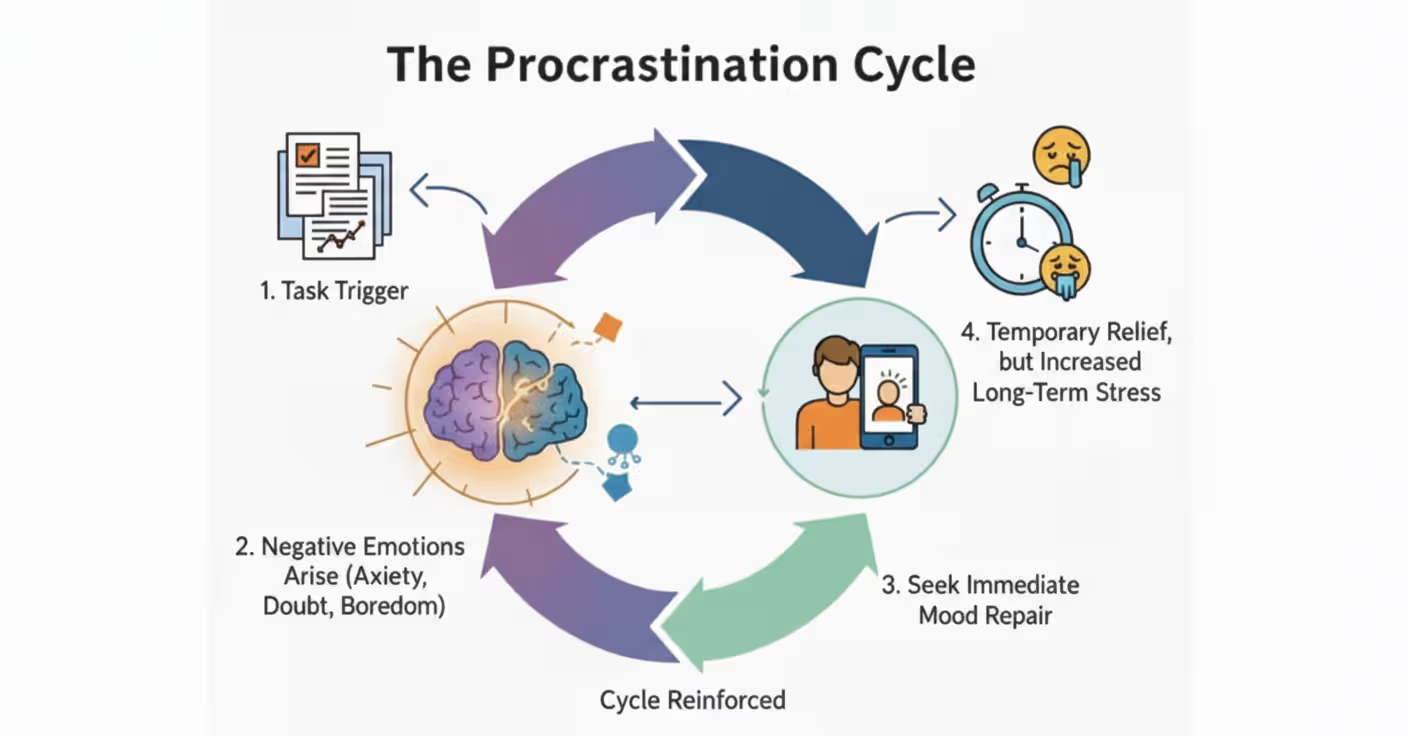
Your behaviors are the ultimate expression of your beliefs. Look for recurring patterns of self-sabotage in your life. Do you consistently procrastinate on important projects related to your career goals? Procrastination is often not a sign of laziness but a coping mechanism driven by a fear of failure or success, which is rooted in limiting beliefs. Do you avoid networking events, fail to set healthy boundaries with colleagues, or consistently undersell your achievements in performance reviews? These are not isolated habits; they are strategic behaviors orchestrated by your subconscious to keep you safely within the confines of your limiting beliefs. By identifying these patterns, you can reverse-engineer them to discover the underlying assumptions that are driving your actions.
The Path to Permanent Freedom: Strategies for Transformation
Identifying your limiting beliefs is a revelatory step, but awareness alone is not enough to dismantle them. Permanent freedom requires a deliberate, multi-faceted strategy that challenges the belief at a cognitive level, rewires it at a neurological level, and manages it at an emotional level. This is not about layering positive affirmations over a negative foundation; it is about systematically deconstructing the old structure and building a new, empowering one in its place.
Challenging and Deconstructing Limiting Beliefs
Once a limiting belief has been identified, it must be put on trial. This cognitive restructuring process involves acting as a detective and a lawyer, scrutinizing the belief from all angles.
- Seek Evidence: Where is the concrete, indisputable evidence for this belief? And what is the evidence against it? A belief like "I am terrible at public speaking" can be countered by recalling even small instances where you successfully communicated your ideas to a group.
- Explore Alternative Interpretations: Is there another way to view the situation that gave rise to this belief? Perhaps a past "failure" was not a reflection of your incompetence but a result of insufficient preparation or external factors.
- Analyze the Impact: What is the cost of holding onto this belief? How has it affected your career, your relationships, and your mental health? Conversely, what would become possible if you let it go? This cost-benefit analysis weakens the emotional attachment to the belief by highlighting its destructive nature.
Cultivating an Empowering Growth Mindset
The most powerful antidote to a limiting belief system is a growth mindset. This is the fundamental belief that your abilities and intelligence can be developed through dedication and hard work. Adopting this mindset involves reframing your internal narrative. Instead of thinking, "I can't do this," you shift to, "I can't do this yet." Challenges are no longer seen as threats that might expose your inadequacies, but as opportunities to learn and expand your skills. Failure is reframed from a verdict on your worth to a vital part of the learning process. According to a Stanford study, a simple one-hour intervention designed to shift mindset toward seeing growth opportunities can lead to significantly lower levels of depression, demonstrating the profound impact of altering core beliefs on mental health.
Building New Neural Pathways: Action-Oriented Steps
Beliefs are not just abstract thoughts; they are fortified neural pathways in the brain. To break them, you must create new, stronger pathways. This is achieved through consistent, deliberate action that contradicts the old belief. If you believe you are not a leader, volunteer to lead a small, low-stakes project. If you believe you are bad at networking, set a goal to have one brief conversation at your next professional event. These small, manageable "behavioral experiments" provide your brain with new evidence. Each successful action serves as a data point that weakens the old belief and strengthens the new one. As noted by GHP News, this rewiring process takes time, with estimates ranging from 21 to 66 days or more, emphasizing the importance of consistency.
Addressing Emotional Attachments and Core Beliefs
Often, we have a strong emotional attachment to our limiting beliefs. They may provide a strange sense of comfort, identity, or safety by absolving us of the responsibility to try and potentially fail. It is crucial to acknowledge and process these underlying emotions. Techniques from Dialectical Behavior Therapy (DBT), such as mindfulness and distress tolerance, can be invaluable here. They teach you to observe the anxiety or fear that arises when you challenge a belief without immediately reacting to it. This creates a space between the emotional trigger and your response, allowing you to choose an action aligned with your new, desired belief rather than being controlled by the fear associated with the old one. This is essential for addressing the deep-seated core beliefs that underpin many surface-level limitations.
Strategic Environmental Design and Boundary Setting
Your environment can either reinforce your limiting beliefs or support your growth. If you are surrounded by people who echo your negative assumptions, change will be exponentially harder. It is essential to curate your environment strategically. This may mean spending more time with a supportive coach, mentor, or colleagues who hold a growth mindset. It also involves setting firm boundaries with individuals who consistently undermine your confidence. This includes limiting conversations that devolve into complaint sessions or politely refusing to engage with unsolicited, unconstructive criticism. Creating a supportive environment reduces the cognitive load required to fight your internal battles and provides external reinforcement for the new beliefs you are working to build.
Conclusion
The journey from being constrained by limiting beliefs to living a life of expansive potential is one of the most transformative endeavors an individual can undertake. These invisible chains—forged in childhood, reinforced by experience, and automated by the subconscious—carry a profound and hidden cost that extends across our careers, our psychological well-being, and our fundamental capacity for growth. They are the silent architects of stagnation, anxiety, and unfulfilled goals.
However, these beliefs are not immutable facts; they are learned patterns, and what has been learned can be unlearned. The path to freedom begins with the courage to turn inward, developing the self-awareness to listen to our internal dialogue and identify the self-sabotaging patterns in our behavior. It requires the analytical rigor to deconstruct these false assumptions, challenging them with evidence and logic until their power dissolves.
Most importantly, permanent transformation is an active process. It is achieved not merely by thinking differently, but by acting differently. By consciously cultivating a growth mindset, taking small, consistent steps that defy old limitations, managing the emotional discomfort of change, and strategically designing a supportive environment, we can systematically build new neural pathways. This process rewires our brain for a new reality—one where challenges are opportunities, feedback is a gift, and our potential is not a fixed ceiling but an ever-expanding horizon. Breaking free from limiting beliefs is the ultimate act of reclaiming personal agency, allowing you to become the deliberate author of your own story.