In an age defined by perpetual connectivity and an endless stream of information, the ability to concentrate has become a modern superpower. Yet, for many, this power feels increasingly out of reach. We are bombarded by notifications, pulled in a dozen directions by competing priorities, and often sabotaged by our own wandering minds. According to a study from the University of California, Irvine, the average office worker gets interrupted every 11 minutes and takes over 23 minutes to get back on track source. The cost is significant: diminished productivity, increased stress, and a lingering sense of being perpetually behind.
The common response is to search for quick fixes—a new app, a simple productivity hack—but these often fail to address the root of the problem. This article rejects surface-level solutions. Instead, it presents a comprehensive, five-phase strategic blueprint for mastering distraction management. This is not about finding more willpower; it's about building an intelligent system that protects your attention, cultivates deep focus, and empowers you to do your best work, even in a world designed to distract you.
What are the most effective techniques for managing distractions?
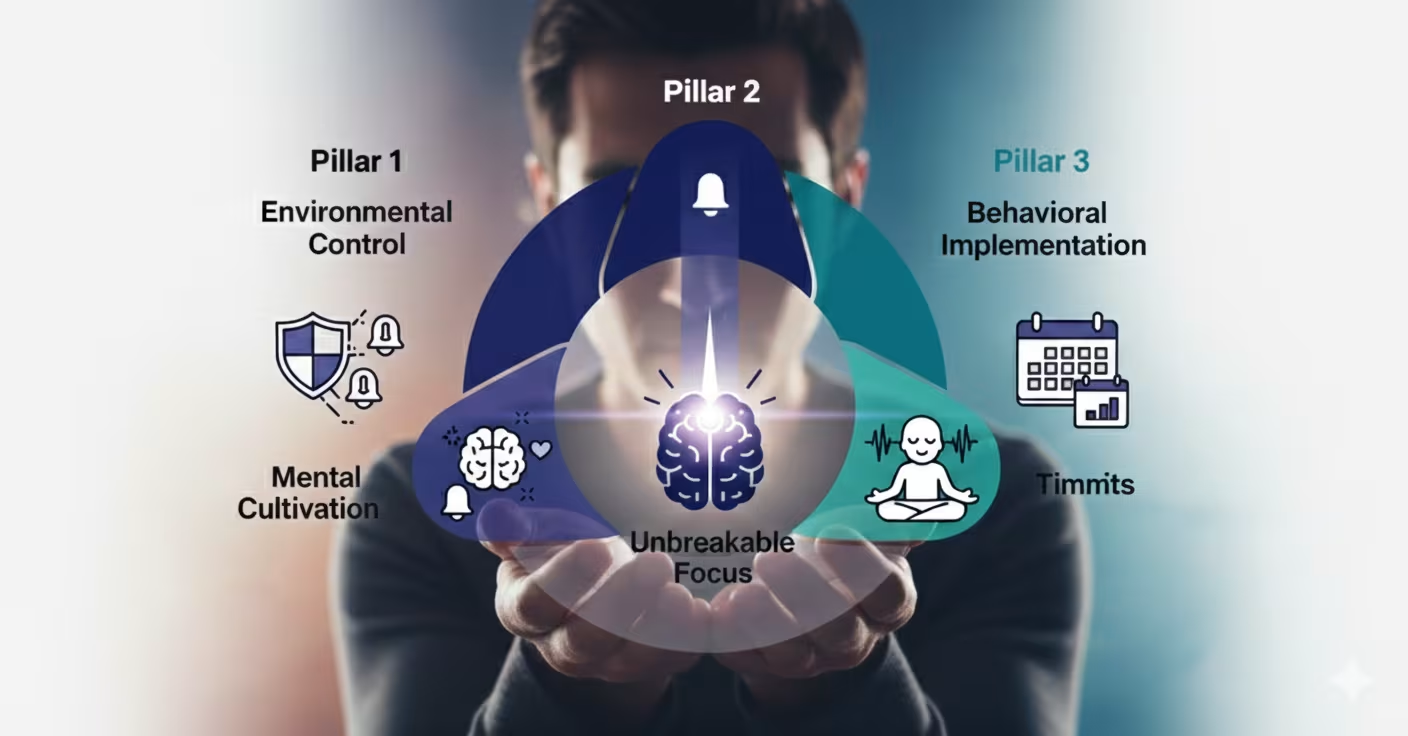
 The three core pillars of an effective distraction management strategy: controlling your environment, training your mind, and structuring your work.
The most effective techniques for managing distractions are not isolated tactics but components of an integrated strategy. This strategy operates on three fundamental levels. First is environmental control, which involves consciously designing your physical and digital spaces to minimize interruptions and cues for distraction. This could mean decluttering a workspace, using noise-canceling headphones, or employing software to block distracting websites. Second is mental cultivation, which focuses on training the mind's internal capacity for focus through practices like mindfulness, managing cognitive biases, and improving emotional regulation. The goal is to build resilience against internal distractors like anxiety or mind-wandering. Third is behavioral implementation, which involves adopting structured work methodologies like time blocking, task batching, and Deep Work to direct your cultivated focus with precision and intent.
How do I stop getting distracted so easily?
Stopping the cycle of easy distraction requires moving from a passive to an active relationship with your attention. It is not a matter of pure willpower but of strategic system-building. The answer lies in a multi-phase process that begins with understanding why and how you get distracted. You cannot fight an enemy you do not understand. The first step is a thorough diagnosis of your personal distraction landscape, identifying both the external triggers and the internal thought patterns that pull you off task. Following this diagnosis, you must proactively fortify your environment, build inner mental resilience, and implement proven focus techniques. This methodical approach transforms the abstract desire to "be less distracted" into a concrete, actionable plan. It shifts the focus from resisting temptation to creating conditions where focus is the natural default.
Phase 1: Diagnosing Your Focus Landscape – Understanding the Enemy Within and Without
Before constructing any defense, a commander must first understand the terrain and the nature of the opposing forces. In the battle for focus, this means conducting a thorough reconnaissance of your own mind and environment. This diagnostic phase is the bedrock of your entire strategy. Without a clear understanding of what specifically derails your attention, any attempts to improve will be based on guesswork. This phase is about gathering intelligence—identifying the patterns, triggers, and root causes of your personal distraction habits. It requires honest self-assessment to map out the internal and external forces that vie for your cognitive resources.
The "Why" Behind Distraction: A Brief Cognitive Dive
At a fundamental level, our brains are wired for distraction. This is not a personal failing but an evolutionary feature. Our ancestors survived by maintaining a state of vigilant awareness, ready to shift attention to potential threats or opportunities. This is driven by a cognitive mechanism known as novelty bias, where the brain prioritizes new and unexpected stimuli over the familiar. Furthermore, many modern distractions, particularly digital ones, are engineered to exploit our brain's reward system. Each notification, "like," or new email triggers a small release of dopamine, a neurotransmitter associated with pleasure and motivation. This creates a feedback loop that trains the brain to seek out these small, frequent rewards, making the sustained effort of deep focus seem less appealing in the moment.
Identifying Your Internal Saboteurs: The Mind's Own Distractions
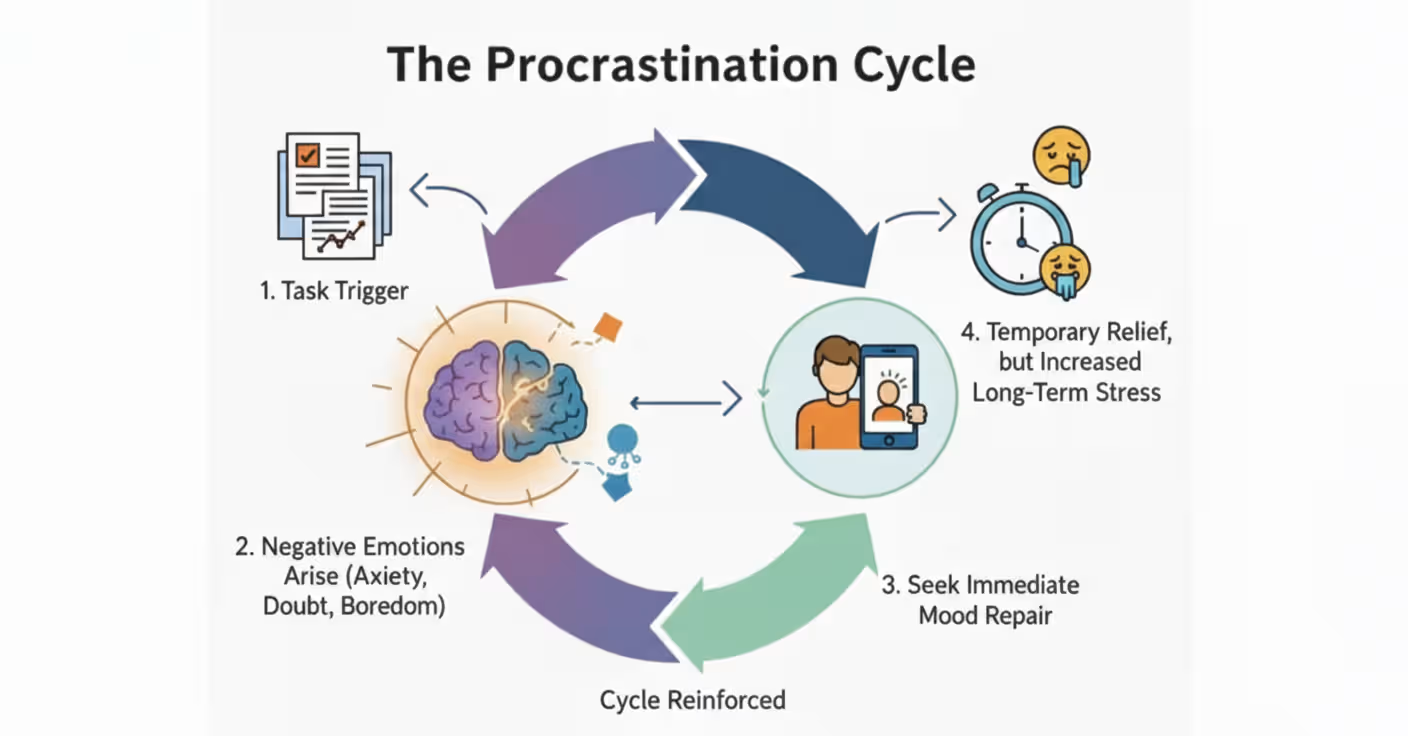
While external interruptions are obvious, the most persistent distractions often originate from within. These internal saboteurs are the unbidden thoughts, emotions, and physiological states that pull your focus away from the task at hand. They can be categorized into several key areas. First are cognitive distractions, such as mind-wandering, daydreaming, or ruminating on past events or future worries. These are the default state of an unfocused mind. Second are emotional distractions, where feelings like anxiety, stress, boredom, or frustration make it difficult to concentrate. The mind becomes preoccupied with processing the emotion rather than the task. Finally, there are physiological distractions—hunger, thirst, fatigue, or physical discomfort. Ignoring these basic bodily signals creates an undercurrent of distraction that erodes your focus over time.
Mapping Your External Interceptors: The World's Demands
External interceptors are the tangible interruptions that originate from your environment. In the modern world, these are relentless and multifaceted. Digital distractions are chief among them, encompassing the constant barrage of notifications from email, social media, and messaging apps. Each alert is a direct bid for your attention. Environmental distractions relate to your physical surroundings. This includes auditory noise from colleagues, family members, or construction, as well as visual clutter on your desk or in your room. A chaotic environment often fosters a chaotic mind. Lastly, there are social interruptions from colleagues, family members, or friends who make an unplanned request for your time. Mapping these requires noting not just what interrupts you, but how often and in what context.
The Distraction Audit: Pinpointing Your Personal Pitfalls
Theory must be translated into data. The Distraction Audit is a practical exercise to move from general knowledge to specific self-awareness. For a period of three to five days, keep a simple log. This can be a notebook or a digital document. Each time you find yourself distracted, note three things: 1) The time of day, 2) The source of the distraction (e.g., "phone notification," "thought about weekend plans," "coworker question"), and 3) The task you were supposed to be doing. After the audit period, review your log for patterns. Do distractions peak at a certain time? Is one source—like email—responsible for the majority of interruptions? Are you more prone to internal distraction when working on specific types of tasks? This data provides an objective foundation upon which to build the rest of your strategic blueprint.
Phase 2: Fortifying Your Environment – Building Your Focus Sanctuary
With a clear diagnosis of your primary distractors, the next phase is to proactively engineer an environment that supports focus and minimizes interruptions. This is not about finding a mythical, perfectly silent location, but about exerting deliberate control over your immediate surroundings to reduce cognitive friction. A fortified environment acts as a first line of defense, making focus the path of least resistance. It involves shaping both your physical workspace and your digital landscape to align with your intentions, creating a sanctuary where deep work can flourish. This phase also extends to the social environment, requiring the establishment of clear boundaries that protect your most valuable assets: time and attention.
Crafting the Ideal Physical Workspace: Whether at Home or Office
Your physical environment sends constant signals to your brain. A cluttered, disorganized space signals chaos and can elevate stress, while a clean, well-ordered space promotes mental clarity. Start by defining a dedicated workspace. This psychologically primes your brain for work when you enter that space. Minimize clutter on your desk, keeping only essential items within reach. Optimize ergonomics—your chair, desk height, and monitor position—to prevent physical discomfort from becoming a distraction. Control your sensory inputs. If you are sensitive to noise, use noise-canceling headphones or a white noise machine. Ensure adequate lighting to prevent eye strain and fatigue. The goal is to create a low-friction environment where your mind doesn't have to expend energy fighting its surroundings.
Mastering Digital Distractions: The Art of Digital Minimalism
In the 21st century, the digital environment is often more distracting than the physical one. Mastering it requires a philosophy of digital minimalism—the intentional use of technology for specific, high-value purposes, while ruthlessly eliminating everything else. Begin with a notification audit. Turn off all non-essential notifications on your phone and computer. For those that remain, customize their delivery (e.g., sound off, no banner). Schedule specific times for checking email and communication apps, rather than letting them interrupt you throughout the day. Utilize technology against itself: employ focus apps or browser extensions that block distracting websites for set periods. Organize your digital desktop as you would your physical one, removing clutter and arranging tools for easy access.
Setting Boundaries: Protecting Your Time and Attention
A fortified environment is incomplete without well-defined boundaries. These boundaries must be established with others and with yourself. For external interruptions, this means clearly communicating your availability. This can be as simple as closing your office door, putting on headphones as a "do not disturb" signal, or using a status message in your communication app. It is crucial to be able to politely decline or defer an immediate request. A simple phrase like, "I'm in the middle of focused work right now, can I get back to you in an hour?" can be incredibly effective. Internal boundaries are equally important. This involves creating rules for yourself, such as a "no phone for the first hour of the day" rule or committing to finishing a specific task before allowing yourself a break for social media.
Phase 3: Cultivating Inner Resilience – Training Your Mind for Unbreakable Focus
While an optimized environment provides a crucial defense, true focus mastery is an internal skill. External fortifications can be breached, and internal saboteurs are always present. This phase is about cultivating the mental and physiological resilience to maintain concentration despite these challenges. It involves training your attention like a muscle, managing your internal state, and developing a conscious relationship with your thoughts. This is where you build the cognitive architecture that allows you to direct your focus with intention, rather than being at the mercy of fleeting impulses and emotions. This inner work transforms focus from a fragile state into a robust and reliable capacity.
The Power of Mindful Awareness: Anchoring Your Attention
Mindfulness is the practice of paying attention to the present moment without judgment. It is the fundamental training ground for focus. Through practices like meditation, you learn to anchor your attention, typically on the breath, and gently guide it back whenever it wanders. This simple act performs two critical functions. First, it strengthens the attentional "muscles" of the brain, specifically the prefrontal cortex, which is responsible for executive functions like concentration and impulse control. Second, it cultivates metacognitive awareness—the ability to observe your thoughts from a distance without getting entangled in them. You begin to notice when your mind starts to drift much sooner, allowing you to redirect your focus back to the task before you are completely derailed.
Harnessing Your Energy: Sleep, Nutrition, and Movement for Cognitive Peak Performance
Your brain is a biological organ, and its performance is directly tied to your physical well-being. Cultivating focus without addressing your foundational energy levels is an uphill battle. Sleep is paramount. During sleep, the brain consolidates memories and clears out metabolic waste products that accumulate during waking hours. Chronic sleep deprivation severely impairs attention, memory, and decision-making. Aim for 7-9 hours of quality sleep per night. Nutrition also plays a vital role. A diet high in processed foods and sugar can lead to energy crashes and mental fog, while a balanced diet rich in complex carbohydrates, healthy fats, and proteins provides a steady supply of fuel for the brain. Finally, regular physical movement increases blood flow to the brain, reduces stress, and releases endorphins that can improve mood and cognitive function.
Managing Internal Dialogue: Developing a Conscious Response to Your Mind's Chatter
Our minds are constantly producing a stream of internal dialogue. Much of this chatter is automatic, and often, it is counterproductive to focus ("This is too hard," "I'd rather be doing anything else," "I'll never finish this"). The key is to shift from an automatic reaction to this chatter to a conscious response. The first step is to notice the thought without judgment. Simply acknowledge it: "There's the thought that this is boring." The next step is to challenge or reframe it. Instead of accepting "I can't focus" as a fact, you might reframe it as, "I am feeling challenged to focus right now, so I will work on this for just 10 more minutes." This practice creates a crucial space between the distracting thought and your behavior, allowing you to choose a response that aligns with your goals.
The Art of Deliberate Practice: Building Unshakeable Focus Habits
Focus is a skill, and like any skill, it improves with deliberate practice. This involves engaging in activities that challenge your attentional capacity in a structured way. Start with short, dedicated focus sessions. Set a timer for 25 minutes (a technique known as the Pomodoro Technique) and commit to working on a single task without any interruptions. When the timer goes off, take a short break. Gradually, you can increase the duration of these focus intervals. During these sessions, your sole objective is to maintain concentration on the task. Each time your mind wanders and you bring it back, you are performing a "rep" that strengthens your focus muscle. This structured approach to building focus is far more effective than simply hoping for concentration to appear.
Phase 4: Implementing Strategic Focus Techniques – Your Blueprint in Action
With a fortified environment and a resilient mind, it's time to apply proven operational strategies. This phase is about structuring your work and managing your tasks in a way that maximizes your capacity for deep, uninterrupted concentration. These techniques are the practical application of the principles developed in the previous phases. They provide the frameworks and methodologies that translate your intention to focus into tangible output. By adopting these strategies, you move from simply defending against distractions to actively creating the conditions for peak performance and profound productivity.
Deep Work: The Cornerstone of Unbreakable Focus
Coined by author Cal Newport, "Deep Work" refers to professional activities performed in a state of distraction-free concentration that push your cognitive capabilities to their limit. These efforts create new value, improve your skills, and are hard to replicate. Deep work is the opposite of the shallow, low-value, logistical-style work that fills many of our days. Mastering focus requires making deep work a priority. This involves scheduling specific, inviolable blocks of time in your calendar dedicated solely to your most cognitively demanding tasks. During these blocks, all potential distractions—phone, email, social media—are completely shut off. It is in these extended periods of intense, single-tasking focus that true breakthroughs occur.
Time Blocking and Batching: Structuring Your Day for Intentionality
Time blocking is a time management method that involves scheduling every part of your day. Instead of working from a to-do list, you assign each task a specific block of time in your calendar. This proactive approach prevents you from drifting between tasks and forces you to confront the reality of how much time you actually have. Task batching is a complementary strategy where you group similar tasks together and execute them in one dedicated time block. For example, instead of answering emails as they arrive, you schedule two 30-minute blocks per day solely for email processing. This prevents the constant context-switching that drains cognitive energy. By combining time blocking and batching, you create a clear, intentional plan for your day.
The Flow State: Achieving Peak Productivity and Engagement
Flow, a concept identified by psychologist Mihaly Csikszentmihalyi, is a mental state of being fully immersed in an activity, characterized by energized focus and enjoyment in the process. It is the epitome of unbreakable focus. While flow cannot be forced, you can create the conditions that make it more likely to emerge. There are three primary requirements: 1) A clear set of goals for the task at hand, 2) Immediate feedback on your progress, and 3) A balance between the perceived challenge of the task and your own perceived skills. When a task is too easy, you become bored; when it's too difficult, you become anxious. The deep work and time-blocking practices described above are instrumental in creating the distraction-free, high-challenge environment where flow can thrive.
Task Management Mastery: From Overwhelm to Clarity
A cluttered mind cannot focus. If you are constantly trying to remember deadlines and pending tasks, your cognitive bandwidth is already overloaded. An effective task management system acts as an external brain, capturing and organizing all your commitments so your mind is free to focus on execution. Methodologies like David Allen's "Getting Things Done" (GTD) provide a comprehensive framework for this. The core principle is to get everything out of your head and into a trusted system. Once captured, you can process these items, organize them by project and context, and create a clear list of "next actions." This systematic approach transforms a vague sense of overwhelm into a clear, prioritized plan, ensuring you are always working on the right thing at the right time.
Phase 5: Adapting & Evolving – Sustaining Your Unbreakable Focus
Mastering focus is not a one-time achievement but a continuous process of adaptation and refinement. A rigid blueprint will eventually break under the pressure of changing circumstances. The final and most crucial phase of this strategy is to build a system for ongoing adjustment. This involves learning to troubleshoot failures, regularly reflecting on your process, and embracing the dynamic nature of focus. Sustaining unbreakable focus over the long term requires treating your system not as a static set of rules, but as a living framework that evolves with your goals, challenges, and understanding of yourself.
Troubleshooting Focus Failures: When the Blueprint Needs Adjustment
Even the most well-designed system will encounter problems. When you find your focus consistently failing, it's time for systematic troubleshooting. First, identify the symptom: procrastination, mental fatigue, or constant derailment. Next, diagnose the cause. Is the task ill-defined? Are you neglecting your well-being? Sometimes, the issue is external and technical—an often-overlooked category of distraction. An unexpected digital disruption, such as persistent Cloudflare Errors that prevent access to a critical online tool, can completely derail a deep work session. These technical glitches create immense friction. Effective troubleshooting in these cases involves knowing how to quickly gather diagnostic information. For instance, providing a support team with the unique Ray ID associated with the error allows them to pinpoint the exact request that failed. Understanding how to find and use a Ray ID transforms you from a passive recipient of digital disruption into an active participant in resolving it, minimizing downtime and getting you back to your focused work faster.
Regular Reflection: Reviewing and Refining Your Strategy
A strategic blueprint requires regular review. Set aside 30 minutes each week to conduct a focus review. Ask yourself a series of diagnostic questions: What went well this week? Where did I struggle to maintain focus? Were my time blocks realistic? Did my environment support my goals? Which distraction patterns re-emerged? This practice of regular reflection allows you to identify what is working and what is not. Based on this review, you can make small, iterative adjustments to your system. Perhaps you need to schedule shorter deep work blocks or be more aggressive with your notification settings. This continuous feedback loop is what transforms a good system into a great one that is perfectly tailored to you.
Embracing Flexibility: The Dynamic Nature of Focus
Unbreakable focus does not mean being rigidly fixated at all times. True mastery includes the flexibility to adapt to changing realities. There will be days when you are operating at peak cognitive capacity and can sustain long periods of deep work. There will also be days when, due to stress, poor sleep, or external pressures, your focus is more fragile. On these days, it is more effective to adapt than to force it. This might mean scheduling shorter focus sprints, tackling less cognitively demanding tasks, or even recognizing the need for a strategic break to recharge. Rigidity leads to burnout and frustration. Flexibility allows you to adjust your approach based on your current capacity, ensuring consistent progress.
The Long Game: Cultivating a Lifetime of Unbreakable Focus
Ultimately, the goal of this blueprint is to cultivate a lifelong skill. It is about fundamentally reshaping your relationship with your attention. This is a long-term investment in your cognitive capital. As you continue to practice diagnosing your landscape, fortifying your environment, building inner resilience, and implementing strategic techniques, the process becomes more automatic. The initial effort required to build these habits lessens over time as they become your default mode of operation. You will develop a deeper self-awareness, a greater sense of control over your time, and an enhanced ability to produce high-quality work that matters. Unbreakable focus is not a destination but a continuous practice that yields compounding rewards.
Conclusion
The modern world wages a constant war for our attention. Winning this war is not a matter of chance or raw willpower, but of strategy. This article has laid out a comprehensive, five-phase blueprint designed to equip you with that strategy. We have moved beyond simplistic tips to construct a holistic system for achieving unbreakable focus.
The journey begins with Phase 1: Diagnosis, where you must first understand the specific internal and external forces that distract you. With this intelligence, you proceed to Phase 2: Fortification, proactively engineering your physical and digital environments to create a sanctuary for concentration. This external defense is then supported by Phase 3: Cultivating Inner Resilience, where you train your mind through mindfulness, energy management, and deliberate practice. In Phase 4: Implementation, you apply powerful techniques like Deep Work and time blocking to direct your focus effectively. Finally, Phase 5: Adaptation ensures your system remains robust and responsive over the long term, even empowering you to troubleshoot unforeseen technical distractions.
By systematically implementing this blueprint, you can transition from being a reactive victim of distraction to a proactive architect of your attention. The path to unbreakable focus is a deliberate one, but the rewards—greater productivity, reduced stress, and the ability to consistently perform at your best—are immeasurable.