An internal monologue is a universal human experience, but when that inner voice becomes a relentless source of judgment, it can significantly diminish one's quality of life. This internal narrator, often termed the "inner critic," is a powerful force that shapes perceptions, influences decisions, and dictates emotional states. While its original intention may be protective—an attempt to prevent mistakes, social rejection, or failure—its methods are often harsh, leading to a cycle of self-doubt, anxiety, and diminished self-esteem. The challenge lies not in eradicating this voice, but in transforming the relationship with it. This guide provides a comprehensive framework for this transformation, moving beyond mere management to cultivate genuine self-compassion and build enduring inner strength. By understanding the critic's origins, learning the language of self-compassion, and applying practical, evidence-based strategies, it is possible to shift this internal dynamic from one of conflict to one of collaboration, turning a source of distress into a foundation for resilience and personal growth.
What are common signs or symptoms of a harsh inner critic?
Recognizing the presence of a harsh inner critic is the first step toward transformation. This internal voice manifests through a variety of cognitive, emotional, and behavioral patterns. A primary sign is persistent negative self-talk, where thoughts are automatically framed with criticism, blame, or judgment. This can sound like "I'm not good enough," "I always mess things up," or "I shouldn't have done that."
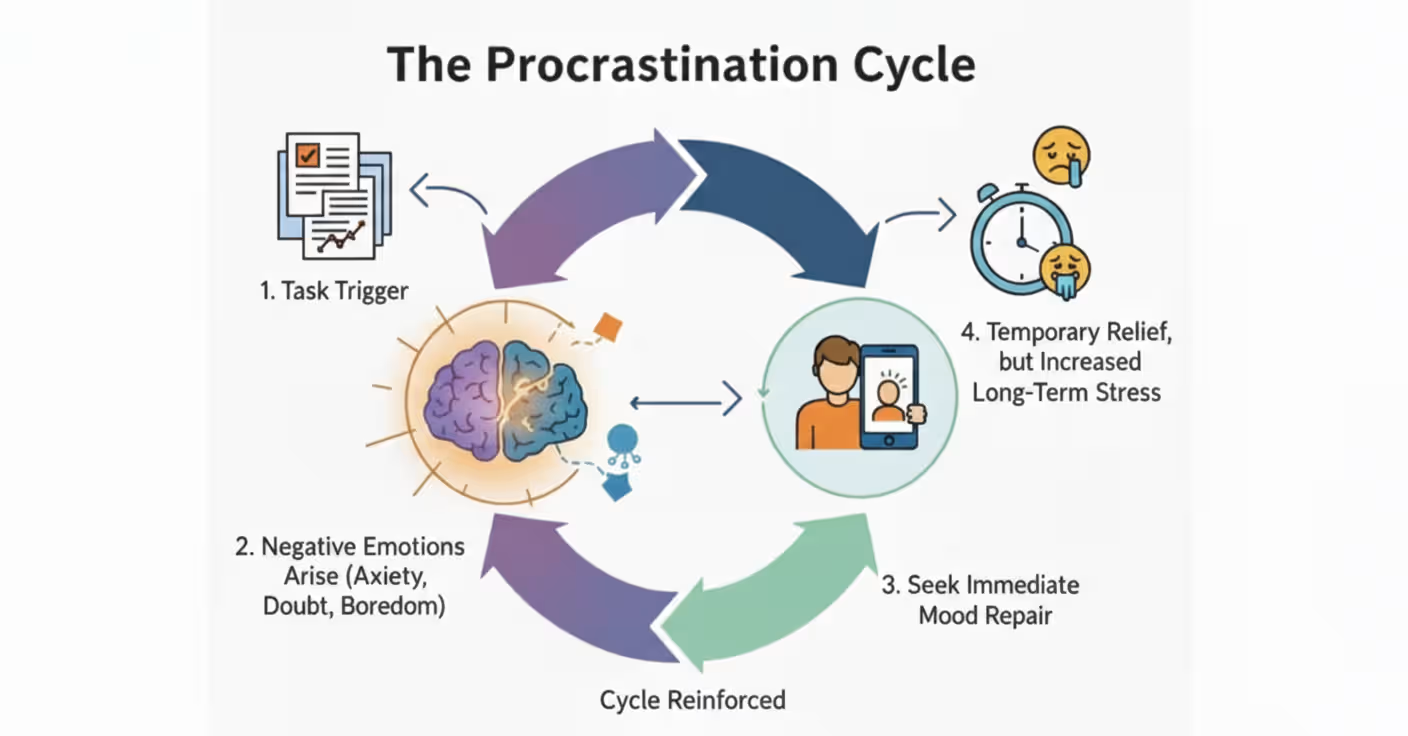
Another key indicator is perfectionism. The inner critic often sets impossibly high standards and then condemns any deviation from them. This can lead to procrastination due to a fear of not meeting these standards, or an inability to feel satisfaction even when success is achieved. Research confirms that perfectionism is strongly associated with serious mental health concerns, including anxiety, depression, and even suicide ideation, as highlighted in analysis by Annosha Mubasher.
Frequent feelings of shame and guilt are also common symptoms. The critic internalizes mistakes as fundamental flaws in character, leading to a pervasive sense of being unworthy or "bad." This is often accompanied by a tendency toward all-or-nothing thinking, where situations are viewed in absolute terms—success or failure, good or bad—with no room for nuance. Behaviorally, this can manifest as social withdrawal, avoidance of new challenges, and difficulty accepting compliments or positive feedback, as the critic dismisses them as undeserved.
What is the inner critic and how does it affect mental health?
The inner critic is the part of one's consciousness that judges, demeans, and doubts the self. It is an internalized voice that often reflects the critical attitudes of parents, teachers, peers, or societal standards absorbed over a lifetime. It is not an objective assessor of reality but a biased commentator shaped by past experiences, including potential trauma. Its function is often a misguided attempt at self-protection—to keep one safe from failure or rejection by pointing out flaws before others can.
The effect of this constant self-criticism on mental health is significant and multifaceted. It is a major contributor to stress, anxiety disorders, and depression. The unrelenting negative self-talk can erode self-esteem, leading to a diminished sense of self-worth and confidence. This internal environment of hostility creates chronic stress, activating the body's fight-or-flight response, which over time can have physiological consequences. The prevalence of mental illness is widespread, with Mental Health America's 2025 data showing that 23.4% of U.S. adults experienced mental illness in 2024, indicating that tens of millions of people may be grappling with such internal struggles.
Furthermore, the inner critic fuels cycles of self-doubt and shame. It can paralyze decision-making, stifle creativity, and prevent individuals from pursuing goals or taking healthy risks. For many, it contributes to feelings of hopelessness, which is a significant concern given that rates of persistent sadness among young people remain high. According to the National Alliance on Mental Illness (NAMI), 40% of U.S. high school students experienced such feelings in 2023, a reality that a harsh inner critic can certainly exacerbate.
When is it necessary to seek professional help for issues caused by an overly critical inner voice?
While self-help strategies are powerful, there are times when the impact of an inner critic necessitates professional support from therapists or coaches. Professional help is advisable when the self-criticism becomes debilitating, significantly impairing daily functioning at work, school, or in relationships. If the negative self-talk leads to severe depression, overwhelming anxiety, or panic attacks, seeking help is crucial.
A critical indicator for seeking professional support is the presence of suicidal ideation. The weight of a relentless inner critic can contribute to profound despair. Statistics highlight the seriousness of this issue; in 2022, over 13 million adults had serious thoughts about suicide. If you or someone you know is having such thoughts, it is imperative to contact a mental health professional or a crisis hotline immediately.
Another sign is when the inner critic's voice is deeply entangled with past trauma. A trauma-informed therapist can help navigate these complex connections safely and effectively, providing tools to heal the underlying wounds that fuel the critic. Additionally, if personal efforts to manage the inner critic have been unsuccessful and the patterns of self-criticism, shame, and self-doubt remain entrenched, a professional can offer structured approaches like Cognitive Behavioral Therapy (CBT), Dialectical Behavior Therapy (DBT), or frameworks like Internal Family Systems (IFS) to facilitate deeper, lasting change.
Introduction: Beyond Silencing – Embracing True Transformation
The Pervasive Power of the Inner Critic
For countless individuals, the inner critic is a constant companion. It is the voice that magnifies failures, minimizes successes, and constantly questions one's worthiness. This internal dialogue is more than just fleeting self-doubt; it is a deeply ingrained pattern of self-criticism that can dictate the course of one's emotional and professional life. It fuels perfectionism, fosters imposter syndrome, and can become a significant barrier to personal growth and happiness. This voice often feels like an immutable part of one's personality, a harsh but necessary motivator. However, research and modern psychology suggest that this is a fundamental misunderstanding of its nature and function.
The Promise of This Guide: Transformation, Not Just Management
Many approaches to dealing with the inner critic focus on silencing, fighting, or ignoring it. This guide proposes a different, more sustainable path: transformation. The goal is not to wage war on a part of yourself but to understand its origins, acknowledge its (misguided) protective intent, and fundamentally reshape your relationship with it. This process involves moving from self-criticism to self-compassion. The promise is not a life devoid of self-reflection but one where that reflection is guided by kindness, wisdom, and an unwavering belief in one's capacity for growth. We will explore a framework that integrates self-awareness, compassion, and structured dialogue to transform your inner critic from an antagonist into an ally, or at the very least, a neutralized and understood part of your inner world.
Setting the Stage: Self-Compassion as the Core of Inner Strength
At the heart of this transformation lies self-compassion. Often misunderstood as self-pity or indulgence, true self-compassion is a cornerstone of psychological resilience and inner strength. It involves treating yourself with the same kindness, care, and understanding you would offer a good friend in a time of struggle. This practice is not about letting yourself off the hook; instead, it provides the secure emotional foundation necessary to acknowledge weaknesses, learn from mistakes, and persevere through challenges without the debilitating weight of shame. As we will explore, cultivating self-compassion is the active ingredient that fuels the journey from self-judgment to self-empowerment, creating the inner conditions for lasting change and genuine well-being.
Decoding Your Inner Critic: Understanding Its Roots and Racket
What is the Inner Critic?
The inner critic is an internal psychological construct—a part of our psyche—that observes and judges our actions, thoughts, and feelings against a set of standards. These standards are rarely our own conscious creation; they are typically internalized from external sources throughout our lives. The critical voices of parents, the competitive nature of school, societal expectations of success, and the curated perfection seen on social media all contribute to the rulebook the inner critic uses. It is the voice of "shoulds" and "should nots," a relentless commentator on our perceived inadequacies. It operates from a place of fear, convinced that its harshness is necessary to motivate us and protect us from the potential pain of failure or social judgment.
The Critic's Misguided Mission: A Protective Part
A transformative perspective, informed by models like Internal Family Systems (IFS), reframes the inner critic not as a malevolent enemy but as a "protective part." From this viewpoint, the critic developed at some point in our lives, often in childhood, to protect a more vulnerable part of us from hurt. For example, if a child was shamed for making a mistake, an inner critic might emerge to ensure they never make that mistake again, believing that its own harsh judgment is preferable to the pain of external shaming. Its mission is fundamentally protective, even if its methods—shame, fear, and relentless criticism—are painful and counterproductive. Understanding this misguided intention is the first step toward shifting from a relationship of conflict to one of compassion and dialogue.
The Cost of Constant Criticism
The cumulative effect of living with a dominant inner critic is profoundly damaging. This constant barrage of negative self-talk erodes self-esteem, making it difficult to recognize one's strengths or accept accomplishments. It creates a state of chronic stress, as the body and mind are perpetually on high alert for the next perceived failure. This environment is toxic to mental health, directly contributing to anxiety and depression. As noted by Applied Positive Psychology, individuals who practice self-compassion are demonstrably less likely to suffer from high levels of these conditions. The inner critic also stifles growth; the fear of its judgment can lead to risk aversion, preventing us from trying new things, speaking up, or pursuing ambitious goals. It traps us in a cycle of self-doubt and inaction, limiting our potential and diminishing our overall well-being.
The Transformative Power of Self-Compassion: Building Strength, Not Just Soothing Pain
What Self-Compassion Truly Is: Beyond Self-Pity
Self-compassion is frequently misunderstood. It is not self-pity, which involves wallowing in one's problems and feeling that they are uniquely terrible. Nor is it self-indulgence, which means gratifying every whim without regard for long-term well-being. According to its leading researcher, Dr. Kristin Neff, self-compassion has three core components. First is self-kindness, which involves being gentle and understanding with ourselves rather than harshly critical. Second is a sense of common humanity, recognizing that suffering and personal inadequacy are part of the shared human experience—everyone struggles. The third is mindfulness, which requires taking a balanced approach to our negative emotions so that we neither suppress nor exaggerate them. Together, these elements create a powerful mindset that is both nurturing and grounded in reality.
How Self-Compassion Fuels Inner Strength and Resilience
Contrary to the belief that self-criticism is the key to motivation, self-compassion is a far more effective fuel for inner strength and resilience. A harsh inner critic can be paralyzing, but a compassionate inner voice provides the safety needed to acknowledge failures and learn from them. Resilience is the ability to bounce back from adversity. A notable four-year study cited in Psychology Today found that while stress alone or self-compassion alone did not increase resilience, the combination of experiencing stress while practicing self-compassion did. This suggests that self-compassion is the crucial ingredient that helps us navigate difficult experiences constructively. Further research underscores this connection, with one study of university students finding a significant positive correlation between self-compassion and resilience, demonstrating that one can directly foster the other (ResearchGate).
Self-Compassion as the Engine of Personal Growth
The inner critic operates on the flawed premise that we must be hard on ourselves to improve. However, fear and shame are poor long-term motivators. Self-compassion, on the other hand, creates an internal environment conducive to growth. When we are not afraid of being berated for mistakes, we are more willing to step outside our comfort zones and take on new challenges. It allows us to face our weaknesses with honesty and a desire to improve, rather than hiding from them in shame. Evidence supports this, showing that treating yourself with self-compassion is a better motivator for improving weaknesses and enhancing performance. As Inc. Magazine reports, a self-compassionate mindset makes people more likely to achieve their goals. It shifts the focus from "What's wrong with me?" to "What can I learn from this?"—a question that is infinitely more productive and empowering.
The Transformation Framework: From Critic to Inner Mentor
Step 1: Cultivating Self-Awareness and Identifying the Critic
The first step in any transformation is awareness. You cannot change what you do not acknowledge. This involves practicing mindfulness—paying attention to your thoughts, feelings, and bodily sensations in the present moment without judgment. Begin by simply noticing when your inner critic is active. What situations trigger it? What are its favorite phrases? What tone of voice does it use? You might keep a journal to log these instances of negative self-talk. The act of writing them down creates distance, allowing you to see these critical thoughts as mental events rather than objective truths. This process of externalizing the critic helps you recognize it as a part of you, but not the entirety of you. It is a voice, not your identity.
Step 2: Responding with Self-Compassion
Once you have identified the critic's voice, the next step is to consciously choose a different response. Instead of automatically believing the criticism or arguing with it, respond with self-compassion. This involves actively engaging the three components of self-compassion. First, practice self-kindness by offering yourself gentle and understanding words, just as you would for a friend. You might say, "This is really difficult right now," or "It's okay to make mistakes." Second, remind yourself of your common humanity: "Everyone struggles with this sometimes; I'm not alone." Third, use mindfulness to acknowledge the pain without getting lost in it: "I'm noticing a feeling of shame, and that's okay." This compassionate response soothes the nervous system and directly counteracts the critic's harshness, creating a new neural pathway for how you relate to yourself during times of difficulty.
Step 3: Engaging in Dialogue and Re-parenting with IFS Principles
This step moves from responding to the critic to actively engaging with it. Drawing from Internal Family Systems (IFS), you can approach the critic with curiosity rather than contempt. Ask it questions from a place of genuine interest: "What are you afraid will happen if you stop criticizing me?" or "What are you trying to protect me from?" Listen for the answer without judgment. You will often find that beneath the harsh words lies a deep fear—of failure, rejection, or not being good enough.
This process is a form of "re-parenting," where your compassionate, wise adult self (what IFS calls the "Self") can offer reassurance to this fearful, protective part. You can acknowledge its positive intention while explaining that its methods are no longer helpful. You might say, "Thank you for trying to protect me. I see you're working hard. But I am an adult now, and I have other ways to handle this. I've got this." This dialogue validates the part's existence while gently updating its strategy.
Step 4: Actively Cultivating Your Inner Mentor or Inner Coach
The final step is to intentionally cultivate a new inner voice—an inner mentor, compassionate coach, or wise advocate. This voice embodies the qualities you need most: encouragement, wisdom, perspective, and unconditional support. If the critic focuses on what's wrong, the inner mentor focuses on your strengths, progress, and potential. You can cultivate this voice through various practices. Visualization exercises, where you imagine a wise and compassionate figure offering you guidance, can be powerful. Another technique is journaling from the perspective of your inner mentor, writing yourself a letter of encouragement or advice. Over time and with consistent practice, this supportive voice can become more automatic and accessible, eventually becoming the dominant voice in your internal landscape, guiding you with strength and kindness.
Integrating Your Transformed Inner World into Outer Success
Enhanced Decision-Making and Empowered Risk-Taking
A transformed relationship with your inner critic fundamentally changes how you approach decisions and risks. When decisions are not clouded by the fear of self-recrimination, you can think more clearly and rationally. You are able to weigh pros and cons based on values and goals rather than on avoiding potential shame. This leads to more confident and empowered decision-making. Furthermore, a compassionate inner environment fosters healthier risk-taking. The fear of failure is lessened because you know that if you do stumble, you will be met with self-compassion, not self-flagellation. This psychological safety encourages you to pursue ambitious projects, explore new career paths, and embrace opportunities for growth that a harsh inner critic would have deemed too risky.
Fostering Creativity, Innovation, and Creative Work
Creativity and innovation thrive in an environment of psychological safety. The inner critic is the enemy of the creative process, as it demands perfection from the very first draft, idea, or prototype. This perfectionism can lead to creative blocks and a fear of experimentation. By cultivating an inner mentor, you create a space where it is safe to be imperfect, to experiment, and to iterate. This freedom allows ideas to flow more easily and enables you to engage in the messy, non-linear process that is essential for true innovation. You become more willing to share nascent ideas, receive feedback constructively, and persist through the inevitable challenges of creative work.
Building Healthier Relationships and Setting Stronger Boundaries
The way we treat ourselves internally often mirrors how we allow others to treat us. A harsh inner critic can normalize criticism, making one more tolerant of unhealthy dynamics in relationships. Cultivating self-compassion builds self-worth, which is the foundation for healthy relationships. When you value yourself, you are more likely to be drawn to people who treat you with respect and kindness. Moreover, a strong sense of self-worth empowers you to set and maintain healthy boundaries. You become better equipped to say "no" to requests that drain your energy and to communicate your needs clearly and confidently, fostering relationships built on mutual respect rather than on self-sacrifice.
Increased Resilience and Self-Efficacy in the Face of Challenges
Resilience is not about avoiding difficulty; it is about navigating it effectively. A compassionate inner voice is a powerful resource during challenging times. Instead of compounding a difficult external situation with internal attacks, you can offer yourself support and encouragement. This internal support system helps you regulate your emotions, maintain perspective, and access your problem-solving abilities more effectively. This process builds self-efficacy—the belief in your ability to succeed in specific situations or accomplish a task. Each time you face a challenge with self-compassion, you reinforce the belief that you are capable of handling whatever comes your way, creating an upward spiral of confidence and competence.
Overcoming Imposter Syndrome and Cultivating Genuine Self-Acceptance
Imposter syndrome—the persistent feeling of being a fraud despite evidence of success—is a direct product of the inner critic. The critic dismisses accomplishments as luck or deception and highlights any perceived flaw as proof of incompetence. Self-compassion is the direct antidote. It allows you to accept your successes with grace and to view your imperfections as part of the human experience, not as evidence of your fraudulence. By shifting from self-criticism to self-acceptance, you begin to internalize your achievements and develop a more stable and authentic sense of self-esteem. This allows you to inhabit your role, whether professional or personal, with greater confidence and authenticity, finally feeling that you belong.
Sustaining Your Transformation: Long-Term Practices for Inner Strength
Daily Self-Compassion and Mindfulness Practices
Transformation is not a one-time event but an ongoing practice. Integrating brief, consistent self-compassion and mindfulness exercises into your daily routine is essential for sustaining inner strength. This can be as simple as starting your day with a two-minute mindfulness meditation, focusing on your breath to anchor yourself in the present moment. You can also practice self-compassion breaks throughout the day, especially when you feel stressed or notice the critic arising. This involves pausing, acknowledging the difficulty of the moment ("This is a moment of suffering"), reminding yourself of your common humanity ("Suffering is a part of life"), and offering yourself kindness, perhaps by placing a hand over your heart and saying a kind phrase to yourself. These micro-practices reinforce new neural pathways and make compassion your default response over time.
Continued Journaling for Self-Knowledge and Self-Forgiveness
Journaling remains a powerful tool for long-term maintenance. It is a dedicated space for continued self-discovery and emotional processing. You can use it to track your progress, notice recurring triggers for your inner critic, and celebrate your successes in responding with compassion. A specific practice is to engage in expressive writing about difficult experiences, which allows you to process emotions and gain new perspectives. Furthermore, journaling can be a powerful medium for self-forgiveness. Writing about past mistakes from a compassionate viewpoint—acknowledging the error, understanding the circumstances, and committing to learning from it—can help release the lingering shame and guilt that the inner critic often holds onto. This practice solidifies your identity as someone who is capable of growth and worthy of forgiveness.
Conclusion
Transforming the inner critic is a profound journey from internal conflict to internal harmony. It requires moving beyond the futile attempt to silence a part of oneself and instead embracing a more nuanced approach rooted in understanding, dialogue, and deep compassion. The process begins with recognizing the critic's voice and its common manifestations—perfectionism, relentless self-talk, and shame. From there, it involves understanding its misguided protective mission and acknowledging the steep mental health costs of its constant activity.
The core of this transformation lies in the cultivation of self-compassion, a practice that builds true resilience and inner strength. By treating oneself with kindness, acknowledging our shared humanity, and maintaining a mindful awareness of our emotions, we create the psychological safety necessary for genuine growth. This guide has outlined a practical framework for this work: developing self-awareness, responding with compassion, engaging in dialogue using principles from Internal Family Systems, and actively cultivating a supportive inner mentor.
The benefits of this internal shift extend far beyond feeling better; they translate into tangible outer success. An integrated inner world leads to enhanced decision-making, greater creativity, healthier relationships fortified by strong boundaries, and the resilience to overcome challenges and imposter syndrome. To sustain this change, long-term practices like daily mindfulness and continued journaling are not just helpful but essential. They are the tools that maintain and deepen the pathways of self-compassion, ensuring that your inner mentor, not your inner critic, becomes your primary guide. This is not a quick fix but a lifelong commitment to a more compassionate and empowered way of being. The work is challenging, but the reward is a life lived with greater freedom, authenticity, and enduring inner peace.